
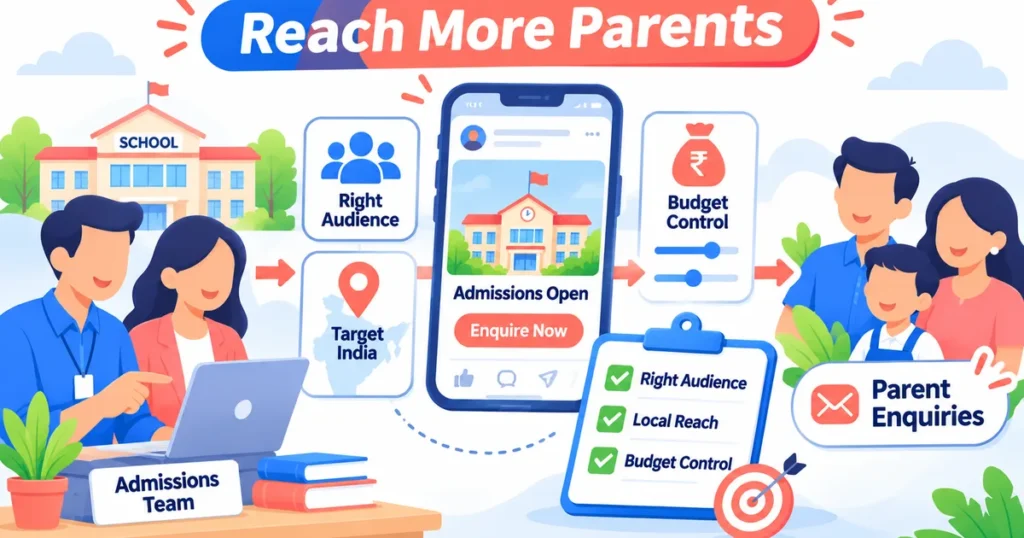
Facebook ads for schools work best when they reach families near the campus, answer real admission questions and make it easy to enquire. Instagram can support the same campaign with engaging visuals and short videos. Neither platform guarantees admissions: the school still needs a clear offer, a useful landing page and a prompt, respectful follow-up. For Indian admissions teams, the practical goal is not maximum clicks. It is relevant conversations with parents who could realistically consider the school.
Start with the admission decision, not the ad format
A parent choosing a school is making a high-trust decision. They may compare travel distance, curriculum, grade availability, safety arrangements, school culture and the admissions process before speaking to anyone. An advertisement that says only “Admissions Open” gives little reason to respond. A useful campaign connects the parent’s immediate question with a credible answer.
Define the outcome before opening Ads Manager. A school seeking nursery enquiries needs different information from one filling limited seats in senior classes. Identify which grades can accept applications, which campus serves the family and what the admissions team can actually promise. If applications are closed, do not run an enquiry ad suggesting otherwise.
Match the message to the parent’s stage
Families discovering a school may appreciate a short campus tour or an introduction to the learning approach. Parents actively comparing options often need admission eligibility, curriculum details, transport information and a visit-booking route. Families ready to act should see an obvious enquiry form, call option or appointment request. Separate these needs in your creative rather than trying to fit every answer into one ad.
Set up Facebook ads for schools around local relevance
A school usually draws from a realistic commuting area, not an entire state. Start with the campus location and the neighbourhoods that families commonly travel from. Check how Meta currently expresses location settings, because its available controls and delivery behaviour can change. Avoid assuming that a selected radius means every person reached lives permanently inside it.
Use language that local families understand. For some schools, English is suitable; others may benefit from clear Hindi or another regional language. Keep the message consistent with the school’s actual communication style. Parent-focused creative should describe the school, not claim that the platform knows someone is a parent or has a child of a particular age.
Avoid over-targeting and unsupported assumptions
Interest labels are not reliable proof of school admission intent. Narrow combinations can also reduce delivery without improving lead quality. Instead, test a sensible local audience against a broader eligible audience and let enquiry quality guide the next decision. Follow Meta’s current rules for targeting, personal attributes and advertising to minors. Admissions campaigns should speak to adults making school decisions, not exploit children’s personal information.
Where the platform offers automated audience expansion, inspect the campaign setup carefully. Keep a written record of the geographic intent, the actual options selected and the resulting enquiries. A nearby but unsuitable lead is still a cost to the admissions team.
Choose campaign objectives that match the next step
An engagement campaign may produce reactions without meaningful admission conversations. A traffic campaign may bring visitors who never contact the school. Lead-generation and messaging options can be useful when the admissions team can respond quickly and capture relevant details. Website conversion campaigns may suit schools with a reliable enquiry page and properly configured measurement.
Instant forms, website forms and messages
Meta instant forms reduce the steps required to submit an enquiry. They can also attract casual submissions if the form asks too little. A website form gives parents more context about the school, but extra loading time or confusing fields can cause drop-offs. WhatsApp or direct messages allow questions, although they require staff to manage conversations and record outcomes.
Whichever route you choose, collect only details needed for a response: parent or guardian contact information, intended grade, preferred campus where relevant and a concise question. Explain why the information is collected, provide the appropriate privacy notice and do not request sensitive information about a child through an advertisement.
Create school ads that parents can assess quickly
Good creative is specific, visually clear and grounded in real school information. Use approved campus photographs, classroom activities or a short tour only when the school has the necessary permissions. Show what families can genuinely expect. Avoid generic “best school” claims, invented rankings or awards and photographs that suggest facilities the school does not offer.
Three useful creative directions
- Campus introduction: show the entrance, learning spaces and a short invitation to explore the school.
- Admissions information: explain which classes are accepting enquiries and direct families to the current admission process.
- School experience: highlight a genuine learning activity, support service or school value with a specific explanation.
A simple headline such as “Explore Admissions at Our Campus” can work when paired with an actual location and a clear next step. Keep text legible on mobile, include captions on videos and avoid placing essential details where platform cropping may hide them. Test different ideas, not merely different background colours.
The landing page must fulfil the ad’s promise. If an ad offers a campus visit, the destination should explain how to request one. If it mentions a particular grade, the page should make that grade’s admission status clear. School digital marketing and social media services can help connect ad creative with a consistent school website and enquiry journey.
Control spend with a clear testing and follow-up routine
A fixed advertising budget should be treated as a learning limit, not a guaranteed cost per admission. Decide how much the school is comfortable spending during the initial test, how long the test will run and what evidence would justify continuing. Do not change budgets and audiences so frequently that results become difficult to interpret.
Test a small number of meaningfully different messages or destinations. Compare the same admission period and campus wherever possible. Pause ads with obvious mismatches, such as repeated enquiries from outside the school’s service area, but avoid judging an ad solely on a few early clicks.
Measure the quality of enquiries
A cheap lead can be expensive if staff repeatedly call people who did not intend to enquire. Record whether the enquiry was reachable, relevant to an open grade, within a feasible commuting area, interested in a visit and eventually converted into an application or admission. Use aggregated reporting and limit access to personal data.

The illustration highlights the practical connection between a school advertisement, parent relevance and budget oversight. The actual campaign should be evaluated through confirmed admissions conversations, not visual appeal alone.
Use a school admissions campaign checklist before launch
| Check | What to confirm |
|---|---|
| Admissions availability | Confirm open grades, campus, eligibility and accurate dates. |
| Audience | Set a realistic local area and check current targeting controls. |
| Creative | Use approved, truthful school visuals and readable mobile text. |
| Destination | Check forms, calls, messages, page speed and privacy notice. |
| Lead handling | Set a response workflow and log enquiry outcomes. |
| Measurement | Check campaign tracking and compare qualified enquiries. |
| Budget | Set a test limit and review spend against useful conversations. |
Before publishing, submit a test enquiry from a phone and follow it through the same process a parent will experience. Check whether the message reaches the right staff member, whether the confirmation is understandable and whether the parent receives an appropriate response. A campaign cannot compensate for unanswered enquiries.
Read results without confusing popularity with admissions
Look beyond impressions, reach and click-through rate. These show whether people saw or interacted with an advertisement, not whether the school reached a suitable family. Useful measures include qualified enquiries, campus visit requests, visits completed, applications started and admissions confirmed. Compare outcomes only where tracking is reasonably consistent.
Keep a simple lead-status sheet or admissions CRM with source, date, grade of interest, response status and next action. Where appropriate, use consented tracking and platform reporting to understand which campaigns contribute to enquiries. Be cautious about attributing every admission to the last ad a parent clicked: school choice often involves recommendations, offline visits and repeated research.
When a campaign underperforms, diagnose the stage. Many views but few clicks may indicate a weak message. Clicks without enquiries may point to a confusing page. Plenty of enquiries but few visits may indicate poor fit or delayed follow-up. The solution depends on the stage where families stop progressing.
Key takeaways for school admissions teams
- Promote real admission opportunities for specific campuses and grades.
- Prioritise families within a realistic commuting area rather than broad reach.
- Choose lead forms, website enquiries or messaging based on staff capacity.
- Show genuine school experiences and obtain appropriate image permissions.
- Judge performance by qualified conversations and visits, not cheap clicks.
- Protect parent and child information throughout the enquiry process.
Frequently asked questions about school social ads
Are Facebook ads useful for school admissions in India?
They can be useful when the school has open seats, a clear local audience and an admissions team ready to respond. Facebook advertising can introduce a campus to nearby families and capture enquiries. Its value depends on enquiry quality and the school’s follow-up, not on clicks alone.
Should a school advertise on Facebook or Instagram?
Both can be tested because families use the platforms differently. Instagram may suit short campus videos and visual stories, while Facebook may support detailed messages and local discovery. Avoid assuming one platform always performs better. Compare qualified enquiries and campus visit requests from each placement.
How much should a school spend on Meta ads?
There is no universal amount that suits every school. Available seats, location, competition, admission timing and the team’s ability to follow up all matter. Start with a spend limit the school can afford to test, then assess qualified enquiries before increasing the budget.
What should a school admission lead form ask?
Ask for the minimum information needed to respond, such as guardian contact details, intended class, preferred campus and the nature of the enquiry. Provide an appropriate privacy notice and explain the follow-up. Avoid collecting sensitive child details or lengthy information before a parent has spoken with the school.
Why do school ads receive enquiries that never convert?
Some people click out of curiosity, live too far away, need a class without vacancies or cannot get a timely answer. Compare ad promises with actual admissions information, check the enquiry form and review response delays. Track reasons for poor fit before changing the audience or spending more.
Build an admissions campaign parents can trust
Facebook ads for schools should help nearby families understand the school and take an informed next step. Strong campaigns connect truthful school information, a manageable budget, an accessible enquiry route and responsive admissions staff. Instagram can extend that approach through useful visual storytelling. The aim is not to generate the largest possible list of names, but to start relevant conversations that the school can support.
For help planning creative, local targeting and enquiry journeys, explore BlinkWorx school digital marketing and social media services. You can also contact the BlinkWorx team or discuss your school admissions campaign on WhatsApp.