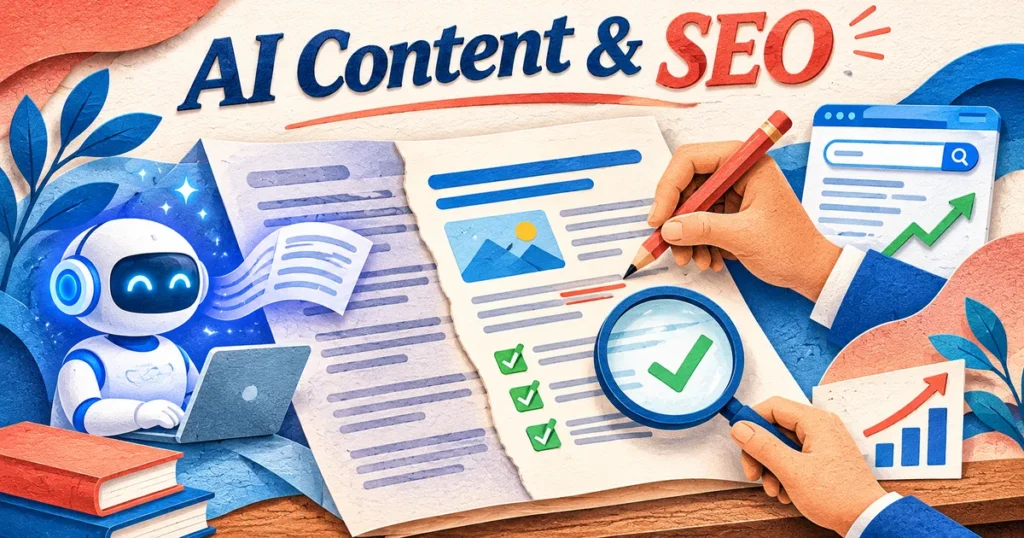
AI can help you research topics, plan outlines and draft content, but publishing its first answer unchanged can harm your website’s usefulness and credibility. The safest approach to AI content SEO is to treat AI as a writing assistant, not an authority: add your own expertise, check facts, improve clarity and serve a real search intent. Google does not automatically penalise content simply because AI helped create it. What matters is whether the finished page is accurate, original, helpful and created for people rather than search-ranking manipulation.
What AI Content SEO Actually Means for Businesses
AI content SEO describes the use of artificial intelligence during search-focused content creation. That can include brainstorming questions, grouping topics, drafting a first version, suggesting headings and polishing language. It does not mean asking a chatbot to produce pages for every keyword and publishing them without scrutiny.
A business blog has a higher bar than a generic information page. Readers may use your advice to select a vendor, change a workflow or spend money. Content should therefore reflect what your business genuinely knows, the audience it serves and the limits of the advice provided.
Google evaluates usefulness, not the identity of the writer
Google Search Central says generative AI can be useful for research and structure. It also warns that generating many low-value pages to manipulate rankings may violate its scaled content abuse policy. Its people-first guidance asks whether a page demonstrates real value, accurate information and appropriate expertise.
For the official wording, see Google’s guidance on generative AI content. This is more reliable than claims that all AI content is banned or that AI text automatically ranks.
Start With Search Intent Before Prompting an AI Writer
A well-written page can still miss its purpose. Someone searching for a definition wants a clear explanation, while someone comparing services needs decision criteria, trade-offs and a sensible next step. Before requesting a draft, write down the reader’s question in ordinary language and decide what would count as a complete answer.
Map a useful page, not a keyword dump
Suppose a marketing agency wants a post about improving enquiry quality. A useful brief might ask the writer to explain why enquiries are unqualified, show where form design and targeting matter, and include ways to follow up. The brief should also identify what not to promise. AI can turn that brief into a proposed outline, but a marketer should decide which points deserve space.
Use the primary keyword naturally in the title or opening, and use related terms where they genuinely help comprehension. Artificial repetition, awkward headings and long lists of near-identical questions make the article harder to read rather than more useful.
Give AI Reliable Inputs Instead of Asking It to Invent Expertise
Many disappointing AI articles begin with a vague prompt such as “write the best SEO post.” Such a request provides no audience context, editorial position, product boundaries or verified source material. The model fills these gaps with plausible-sounding generalisations. Specific inputs make its draft easier to assess and less likely to contain unsupported claims.
Build a source pack
Provide product documentation, approved service descriptions, public policy pages and the reader questions your team hears repeatedly. Separate confirmed facts from opinions. Tell the model not to invent quotations, performance figures, customer experiences or product capabilities. If a claim cannot be confirmed, instruct it to omit or qualify the statement.
For sensitive subjects such as finance, healthcare and legal compliance, a qualified reviewer should verify the material. A fluent paragraph is not proof that its advice is correct. The same principle applies to descriptions of your own products: only publish features and outcomes you can substantiate.
Prompt for gaps and objections
Rather than requesting a final post immediately, ask AI to list assumptions that need verification, questions the reader may still have and alternative explanations. This turns AI into a critic of the draft. Editors can then decide which concerns matter and add real evidence or clearer wording.
A Human Editing Workflow That Protects Content Quality
The difference between a quick AI draft and a strong business article usually appears during editing. A human editor should test whether the text answers the question, sounds credible, and would remain useful if every search keyword were removed. That test prevents writing that exists only to attract a click.
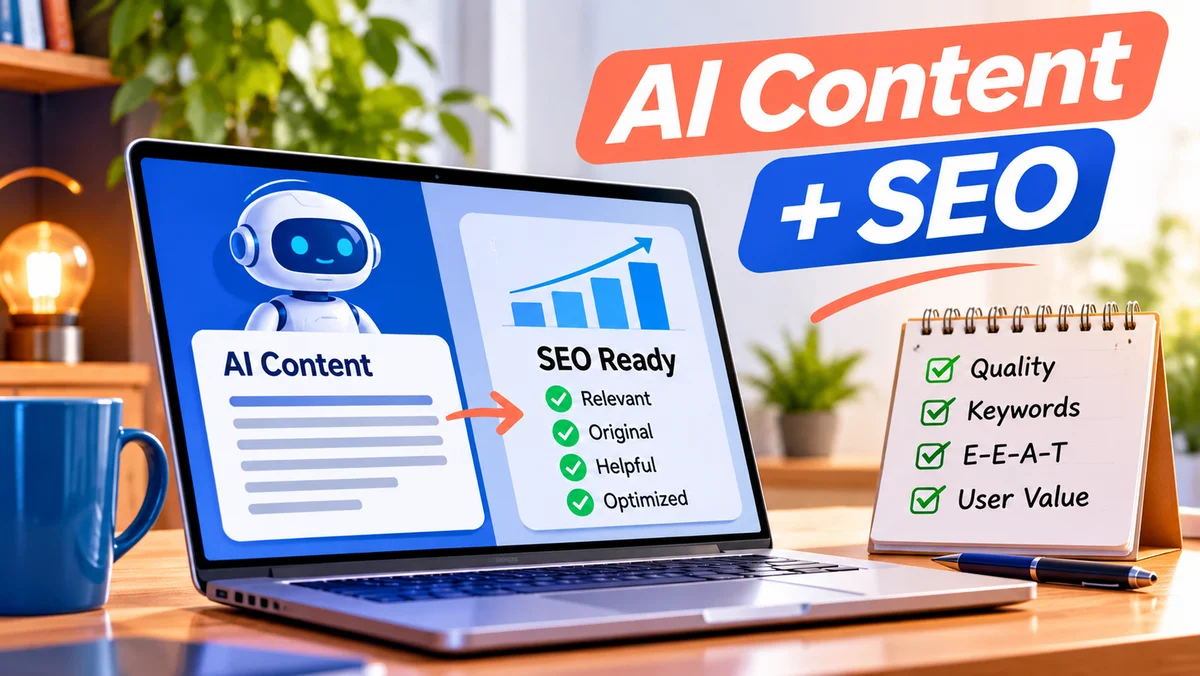
Use this publishing checklist on every AI-assisted page:
- Answer the main question promptly, without making readers scroll through a long introduction.
- Check every factual claim, quotation, name, date and cited link against a reliable source.
- Replace generic advice with your own approved explanations, examples or decision criteria.
- Remove repetitive sentences, inflated promises and claims that cannot be proven.
- Confirm that headings reflect real reader questions rather than forced search phrases.
- Check whether calls to action match the topic and lead to a relevant service.
- Read the complete article on mobile to catch awkward paragraphs and confusing transitions.
- Have a suitable subject expert sign off on specialist or regulated claims.
Editing is also the right moment to challenge the draft’s originality. A paragraph can be grammatically new yet still repeat the same obvious advice found everywhere. Add informed judgments, boundary conditions, practical choices and explanations readers can apply.
Handle Keywords, Links and Metadata Without Over-Optimising
AI can propose search titles, page descriptions, internal links and image descriptions. Those suggestions still require judgment. A title should describe the actual page, not promise a result the article cannot deliver. A meta description should give a clear reason to visit, not cram in synonyms or make guarantees.
Internal links work best when they answer a related need. The destination should expand the reader’s understanding or help with a relevant next step, rather than interrupt the article with a sales message.
A broader campaign may also need BlinkWorx digital marketing services, particularly when content, technical SEO and conversion-focused website pages must work together.
Avoid sending every link to the same generic landing page. Link where the sentence gives useful context, and keep anchor text descriptive. For citations, point to the underlying official source where possible, not an AI-generated summary of it.
Do not outsource image and structured-data truthfulness
An AI-produced image description must match what the image shows. Likewise, schema markup must reflect the visible page and the applicable feature guidelines. A fabricated rating, author credential or FAQ answer can mislead users even if the code validates technically.
Choose the Right Role for AI at Each Stage
Not every content task deserves the same level of automation. A headline brainstorm is low risk; a post claiming a legal obligation is not. The following table gives an editorial starting point for business publishing teams.
| Task | Good AI role | Human responsibility |
|---|---|---|
| Topic discovery | Surface questions and angles | Confirm audience relevance |
| Outline | Suggest structure and missing topics | Set scope and perspective |
| First draft | Produce editable language | Add expertise and remove unsupported claims |
| Research support | List possible sources | Open and verify originals |
| SEO metadata | Suggest titles and descriptions | Check accuracy and natural language |
| Publishing | Flag consistency issues | Approve claims, links and final presentation |
This division of labour keeps the speed benefits while preserving editorial accountability. The person publishing the page remains responsible for its accuracy, whether the first draft came from a colleague, contractor or AI tool.
Measure Whether AI-Assisted Content Helps the Business
Do not judge an article only by how quickly it was produced or whether it contains the target keyword. Look at the reader’s journey. Does the page attract searches that match the topic? Do visitors continue to a relevant service, submit meaningful enquiries or find an answer without confusion? These questions connect content quality with business value.
Search Console can help reveal the queries and pages Google Search surfaces. Website analytics can show engagement and conversions, subject to your measurement setup and consent requirements. Interpret results carefully: a ranking change may reflect competition, indexing, page quality or seasonality, rather than AI usage itself.
Refresh only when there is new value to add
An AI tool can rewrite a dated article in seconds, but changing its wording alone is not necessarily an improvement. Update information that has changed, fix broken references, improve explanations and remove advice that no longer applies. A genuinely better page is more valuable than a cosmetically newer one.
Key Takeaways for Responsible AI Content SEO
- AI can speed up preparation and drafting, but it cannot replace source verification or editorial judgment.
- Google’s focus is helpful, reliable, people-first content, not a blanket ban on AI writing.
- Strong prompts use confirmed inputs and clear reader intent instead of vague requests for rankings.
- Quality checks must include originality, accurate claims, appropriate links and a clear purpose.
- Measure useful search traffic and meaningful actions, not the number of articles published.
Frequently Asked Questions About AI Writing and SEO
Does Google penalise AI-written content?
Google does not say that AI-generated text is automatically penalised. Its guidance focuses on quality and usefulness. Using automation to produce many pages mainly to manipulate rankings can violate spam policies. A business should examine the final page for accuracy, originality, value and a genuine reason to exist.
Can AI write an entire blog post for my business?
AI can create a complete first draft, but that should not be the end of the process. Verify product details, sources and claims, then add your business perspective and edit for clarity. A subject expert should review topics where a mistake could cause financial, legal or other meaningful harm.
Should I disclose that I used AI to write content?
Google recommends considering explanations of how content was created when readers would reasonably expect them. Disclosure is not a substitute for quality, and not every minor AI-assisted edit needs a prominent label. Use a transparent description suited to your audience, topic and actual editorial process.
Will adding more SEO keywords improve AI-generated articles?
Repeating keywords does not make a generic article helpful. Use a clear primary topic, natural headings and related language that answers the searcher’s question. A better improvement is often an explanation, a comparison, a verified example or a useful next step that was missing from the first draft.
How can a small marketing team use AI safely?
Start with lower-risk tasks such as outlines, summaries of approved notes and editing suggestions. Keep a shared source folder and a short pre-publishing checklist. Have a human verify facts and approve the final page. For technical, legal or health-related content, involve someone qualified to assess the advice.
Make AI a Writing Assistant, Not Your Editorial Strategy
The most effective approach to AI content SEO combines machine-assisted efficiency with informed human choices. AI can help your team organise a topic and move past a blank page. It cannot know whether a claim is true for your business, whether a recommendation is safe or whether the article adds something readers cannot find elsewhere. Treat each published page as a useful answer backed by careful review.
Connect Better Content With Better Marketing
If your business wants an editorial process that connects useful articles with search visibility and enquiries, explore BlinkWorx digital marketing services. You can also
contact the BlinkWorx team or discuss your content needs on WhatsApp to discuss your website and content goals.