Children’s Day post ideas for schools work best when they celebrate children’s curiosity, creativity and everyday experiences rather than simply publishing a greeting card. For Indian schools, 14 November is an opportunity to share student artwork, playful classroom moments, teacher messages and school celebrations through thoughtful photos, carousels and short videos. Start with an idea that fits your school community, obtain the required permissions, and make the children the focus of the story. The following ideas can be adapted for Instagram, Facebook, WhatsApp and your school website.
What makes a Children’s Day school post worth sharing?
Parents do not need another generic graphic with the school logo squeezed into the corner. They want a glimpse of the learning environment: how children express themselves, how teachers encourage them, and whether activities feel inclusive. That is why an ordinary picture of a child proudly showing a drawing can be more meaningful than an elaborate promotional montage.
Children’s Day in India is observed on 14 November, the birth anniversary of Jawaharlal Nehru. A short acknowledgement of the occasion can frame the post, but the school’s own celebration should provide the substance. Include the date in captions where relevant, without putting a year in an evergreen article heading.
Plan around an audience and a purpose. Families may enjoy celebration highlights; older students may appreciate a creative challenge; alumni may enjoy childhood memories. Posts should recognise students as people, not turn the day into an admissions sales pitch.
Children’s Day post ideas schools can create from real activities
1. A gallery of small moments
Create a carousel featuring colourful classroom decorations, children making crafts, games in progress and a group celebration. Open with your strongest image, then arrange the sequence like a short story. Write concise captions that explain what happened without identifying individual children unnecessarily.
2. A wall of student dreams
Ask students to draw or write what they hope to learn, invent or become. Share a selection of drawings as a grid, with names omitted unless the school has appropriate permission. This format shows imagination and allows students who do not want to appear on camera to participate.
3. Teachers answer a playful question
Invite teachers to complete the sentence, ‘The best thing children teach us is…’. Film brief, natural responses or turn them into illustrated quote cards. The result can feel sincere when answers are specific rather than rehearsed. Keep student identifiers out of the background.
4. An art-and-craft showcase
Photograph handmade cards, paintings, paper models or classroom murals against a clean background. Add a short description of the activity and the skills it encouraged. A side-by-side view of different art styles is especially suitable for a swipeable post.
5. A schoolyard games reel
Capture short clips of a permitted group game, a relay, a creative challenge or a classroom puzzle. Use gentle transitions and avoid showing any child in an embarrassing moment. If approvals are uncertain, film hands, props, decorations or a teacher demonstrating the game instead.
6. A student-led question board
Invite voluntary responses to a light question such as ‘What makes a school day fun?’. Share answers in a carousel using handwriting, stickers or illustrated speech bubbles. Avoid asking children to reveal personal circumstances, addresses, family details or anything that could make them uncomfortable.
7. A library adventure
Ask the librarian to recommend story themes suitable for different age groups, then show a colourful display of books and bookmarks. A short caption can invite parents to enjoy a reading moment with their children. Do not imply a particular title is officially endorsed unless it is.
8. A kindness chain
Have classes write anonymous notes describing an act of kindness they appreciated. Photograph the notes arranged as a colourful paper chain or pinboard. This turns Children’s Day into a celebration of belonging rather than a contest over who receives the most attention.
9. Student talent without rankings
Share permitted clips of music, storytelling, dance or science demonstrations. Highlight participation and effort instead of awarding public ‘best child’ labels. Where permissions vary, focus on stage decorations, instruments, artwork or a wide shot that does not identify students.
10. A thank-you message from the principal
Record a brief video in which the principal talks about curiosity, friendship and the joy of learning. Use a warm and direct tone rather than a formal speech. A closing invitation to keep asking questions feels more child-centred than a pitch for admissions.
11. Class-created celebration posters
Let students suggest the message and design the artwork. Post the final collective creation with a caption about collaboration. This is an easy option for schools without video equipment and can avoid showing any faces.
12. An after-event memory carousel
Publish a thoughtful recap after the celebration rather than rushing to upload every photo on the day itself. Select a small group of varied moments and explain the event in a few sentences. Keep the school’s privacy and publication approvals intact even when parents request additional pictures.
Make reels and carousels that people can understand quickly
A Children’s Day reel should have a simple beginning, middle and finish. Start with a welcoming shot of the decorated campus or a student-created banner, move into short clips of activities, and end with a collective greeting. Use a calm pace so parents can actually see the moments; fast effects are not a substitute for a story.
For carousels, use a clear cover and alternate close-up details with wider activity scenes. Keep on-image words minimal. High-contrast captions, readable subtitles and descriptions of meaningful visual content make posts more accessible. Background music should be properly licensed for the account and platform being used.
A school can also produce an excellent video without showing a child’s face. Film paintbrushes moving across paper, a handmade card opening, books being arranged, colourful games or teachers preparing surprises. This reduces privacy concerns and provides a distinct creative direction.
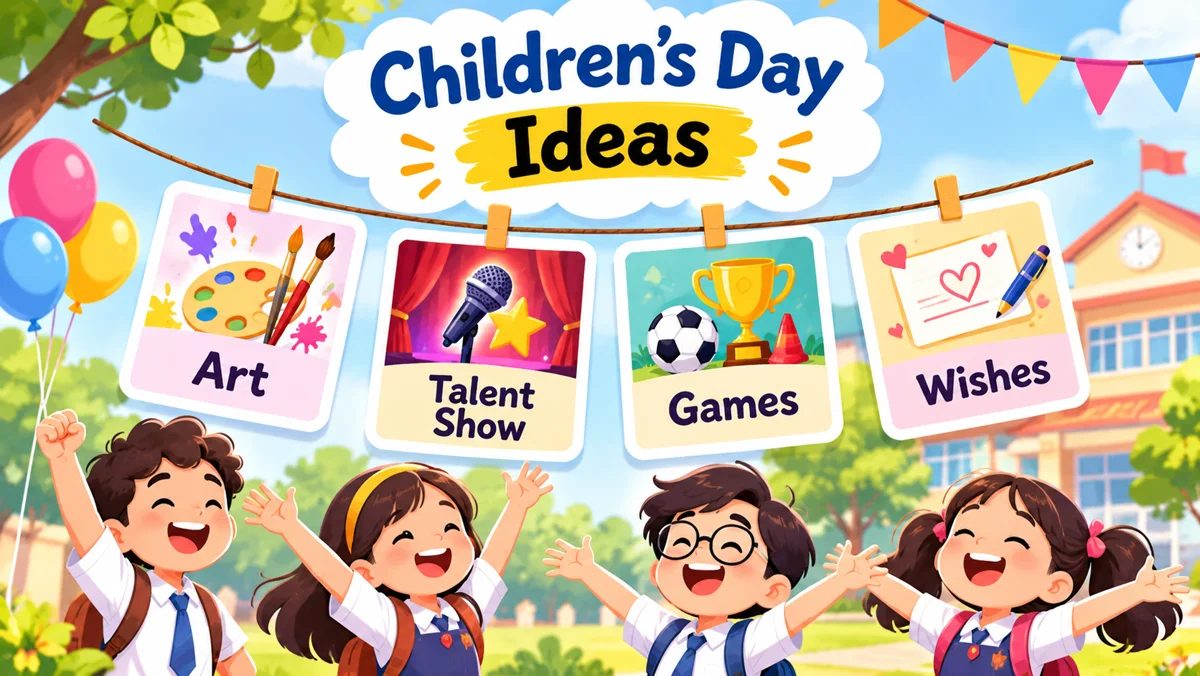
The in-article image shows a sample content-board concept. It is illustrative, not footage of a real school celebration.
Ready-to-adapt Children’s Day captions for Indian schools
Use these examples as starting points. Replace generic descriptions only with activities that actually took place, and do not claim participation, achievements or student reactions that cannot be verified.
Warm greeting for a school page
“Every question, drawing and new discovery reminds us why childhood is special. Wishing our students and families a joyful Children’s Day!”
Caption for an artwork carousel
“Bright ideas came alive in our classrooms as students explored colours, stories and imagination. Here is a glimpse of their Children’s Day creations.”
Caption for a celebration reel
“Smiles, games and shared moments made our school celebration memorable. Here is a little look at the joy of learning together. Happy Children’s Day!”
Short Hindi-English caption
“Har bachche ki creativity aur curiosity ko celebrate karne ka din. Happy Children’s Day to our wonderful learners!”
Do not add a long string of unrelated hashtags. A few descriptive tags about Children’s Day, school activities and the city can be more relevant than generic trending tags. The same principle applies to tagging accounts: obtain permission before tagging students, families or staff.
A simple publishing plan for 14 November
Prepare the content before the event, but leave room for genuine moments. A small school communications team can divide the work into a few clear stages and avoid publishing unapproved images under deadline pressure.
- Before the celebration: decide which activities will be documented, check publication permissions and prepare the visual templates.
- During the event: capture varied moments, photograph artwork and record only approved video material.
- Before posting: check names, dates, photo permissions, subtitles, music rights and spelling.
- On Children’s Day: publish one main post and use stories for smaller approved moments rather than uploading everything at once.
- After the event: share a selective recap, respond to relevant parent comments and archive files securely.
Key takeaways for the school communications team
- Celebrate actual classroom and campus experiences rather than relying only on stock greetings.
- Mix artwork, teacher messages, simple reels and student-led ideas for variety.
- Choose the safest format when consent or visibility is uncertain.
- Write captions that make sense without needing every child to be named or tagged.
- Judge success by meaningful community responses, not only views or likes.
Protect children’s privacy while celebrating their work
Before publishing identifiable images or videos, confirm that the school has valid, sufficiently specific parental or guardian consent and that its own policies and applicable law permit the intended use. Participation should be voluntary. A parent’s consent for an internal newsletter should not automatically be treated as permission for a public social media account.
Avoid student surnames, class-section combinations tied to faces, contact details, home locations, transport information and visible identity cards. Check backgrounds for registers and noticeboards. Do not publish a child in distress, ridicule a mistake, or share sensitive personal information as a feel-good story.
If a parent withdraws permission or flags a post, follow the school’s privacy process promptly. Limit access to raw footage and avoid placing everything in publicly shared folders. For children who cannot appear online, use drawings, decorations and hands-only activity shots so their work can still be included when permitted.
For a broader approach to parent communication and school content, see BlinkWorx’s school social media marketing services. These ideas can fit into an ongoing school communications plan without turning the celebration into an advertisement.
Children’s Day social media FAQs for school teams
What should a school post on Children’s Day?
Post something genuinely connected to your students’ experiences, such as a classroom art carousel, a school celebration recap or a short message from teachers. A generic greeting is fine as a secondary post, but a school-specific moment will usually tell families more about the learning environment and culture.
Can we post children’s photos on Instagram and Facebook?
Only when the intended publication is covered by valid permission and the school has considered its privacy obligations and safeguarding policy. Avoid identifying details and review the background of every image. Where consent is unavailable or unclear, share student artwork, school decorations or non-identifying activity footage instead of faces.
Which is better for Children’s Day: a reel or a carousel?
A reel works well for movement, short performances and a story of the celebration. A carousel is better for artwork, quotes and a sequence of photographs that parents can examine at their own pace. Choose based on what you can capture safely and clearly, not simply because a format is fashionable.
What caption can a principal use for Children’s Day?
A warm caption might say: ‘Our students remind us that learning begins with wonder. Today we celebrate their questions, ideas, friendships and creativity. Happy Children’s Day!’ A principal can add a truthful detail about the school celebration, while keeping the message inclusive and avoiding an unnecessary admissions promotion.
How should schools measure the performance of these posts?
Look beyond likes. Note whether parents leave meaningful comments, share a post with family, visit the school’s event page or respond positively to the school’s communication. Compare similar formats over time, and never pressure children or teachers to generate engagement. Good school communication builds trust, not just reach.
Celebrate childhood with a school story worth remembering
The strongest Children’s Day post ideas for schools are rooted in real student experiences, thoughtful storytelling and careful permissions. Whether your team creates an artwork carousel, a principal message or a short celebration reel, show what makes the day meaningful in your own school. Simple, well-chosen moments can communicate more than an elaborate graphic.
If your school needs help building a consistent publishing calendar around events, admissions and parent communication, explore BlinkWorx’s school digital marketing and social media services. You can also contact the BlinkWorx team or start a WhatsApp conversation to discuss your school’s requirements.