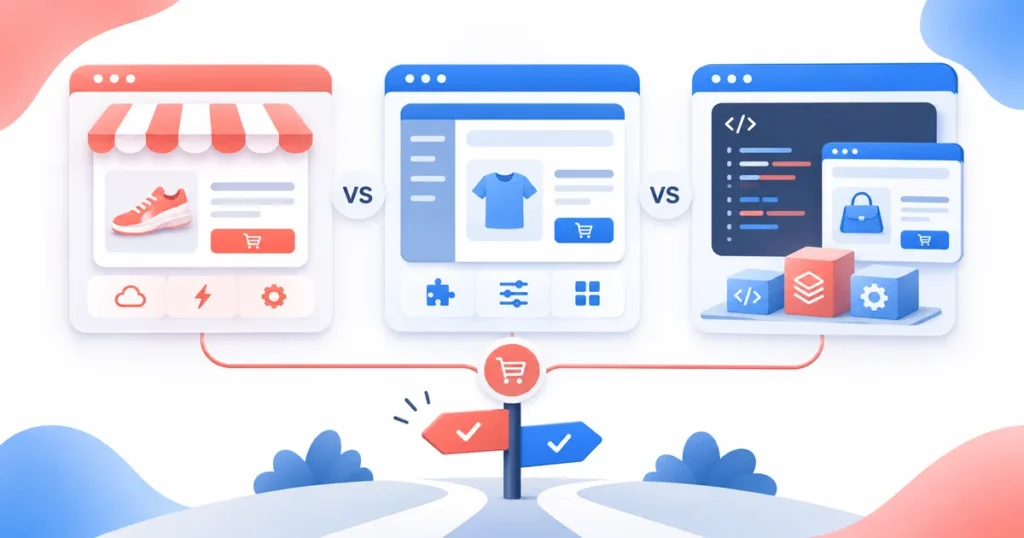
The short answer to Shopify vs WooCommerce is that Shopify is usually easier to launch, WooCommerce offers more ownership and flexibility for WordPress users, and a custom ecommerce build makes sense when your workflow, business model or scale goes beyond what standard platforms handle comfortably. The best choice depends on your budget, internal team, need for control and how much customisation you expect over time.
Shopify vs WooCommerce: the practical difference
Shopify is a hosted ecommerce platform. It manages the core infrastructure for you, which makes it attractive for businesses that want to launch quickly with less technical overhead. WooCommerce is a WordPress plugin that turns a WordPress site into an online store. It gives more flexibility and ownership, but it also places more responsibility on the business or agency handling the site.
A custom ecommerce build sits in a third category. Instead of fitting the store to a template-driven platform, the store is built around your process. That route is heavier, but it is valuable when the business needs advanced workflows, integrations, pricing logic or marketplace-like behaviour.
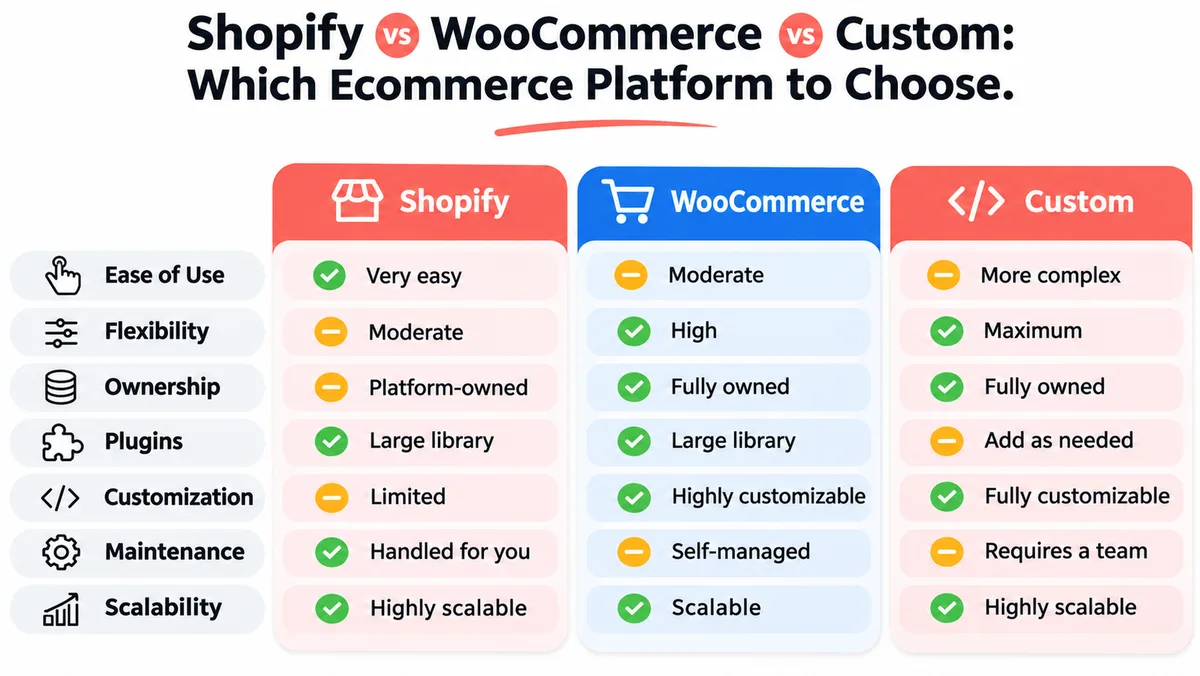
How the three options compare
No platform is universally best. Each one wins in a different context. The right comparison should include control, ownership, maintenance, plugin dependence, scalability and how quickly your team can operate the store day to day.
| Factor | Shopify | WooCommerce | Custom |
|---|---|---|---|
| Setup speed | Fast | Moderate | Slower initial build |
| Ease of use | High | Moderate | Depends on build and admin design |
| Ownership and control | More platform-led | High ownership | Highest control |
| Customization | Moderate | High | Very high |
| Maintenance burden | Lower | Moderate to high | Depends on architecture and support model |
| Scalability path | Strong for many use cases | Good with the right setup | Strong when complex workflows justify it |
When Shopify is the right choice
Shopify is usually a good fit for businesses that want a clean launch process, a straightforward admin experience and a managed platform. It works well when speed matters and the business does not want to manage technical details such as core platform upkeep. It is especially attractive for standard catalog-based stores and teams that want a predictable environment.
Its limitations appear when the business needs deeper logic, unusual checkout flows, complex backend processes or more control over how everything works beneath the surface.
When WooCommerce makes more sense
WooCommerce is a strong choice when the business already uses WordPress, wants more control over content and store structure, or plans to customise the experience over time without jumping straight to a fully custom build. It can be very capable, especially when configured by a team that understands hosting, plugins and performance.
The trade-off is that more flexibility brings more responsibility. Plugin quality, updates, hosting and performance management need closer attention than they typically do on a hosted platform.
When a custom ecommerce platform is worth it
Custom development is usually justified when the store is only one part of a broader business system. Examples include custom pricing rules, B2B workflows, vendor logic, advanced inventory handling, marketplace functions, unusual checkout behaviour or integrations that standard plugins struggle to handle cleanly.
A custom build is not the default answer for every business. It makes sense when the business model itself creates complexity and the store needs to fit the process rather than the other way around.
Migration and long-term growth considerations
Your current choice should also consider where the business will be in one or two years. A fast start is valuable, but so is the ability to scale operations, merchandising, integrations and reporting without rebuilding too soon. That is why platform decisions should reflect not only today’s catalog size but also tomorrow’s operational complexity.
It helps to think beyond storefront design. Consider admin usability, marketing workflows, SEO control, payment options, content strategy and the effort required to maintain the platform over time.
How to choose with more confidence
Instead of asking which platform is best in general, ask which platform best supports your business model, team capability and growth plan. A good decision balances launch speed, flexibility, ownership and support effort.
If you want expert help comparing the right path, BlinkWorx ecommerce website development services can help you decide whether Shopify, WooCommerce or a custom build is the better fit for your store strategy.
It is also helpful to decide how much independence the business wants. Some teams prefer a managed environment with less technical control. Others want deeper ownership because the storefront is a core business asset. The best platform choice is usually the one that aligns operational reality with growth ambition.
Before choosing, clarify how many products you plan to manage, whether there are complex pricing rules, how many team members will update the store and whether there are any unusual integrations or operational workflows. A simple product catalog and a complex multi-channel commerce operation should not be judged by the same criteria.
Questions to answer before making the final choice
Merchandising flexibility matters too. Product grouping, bundles, filters, campaigns and collection management can shape how quickly the marketing team can execute ideas. A platform that supports technical commerce but slows down content and campaign work may create friction for growth teams.
Many ecommerce decisions are influenced by marketing needs as much as technical ones. Businesses that rely heavily on content marketing, landing pages and category strategy should consider how easily the platform supports structured content and agile page creation. This is one reason some businesses prefer WooCommerce when WordPress-driven content is central to growth.
SEO, content and merchandising considerations
Custom ecommerce has the highest long-term responsibility, but that does not automatically make it the wrong choice. If the business needs workflows that standard platforms constantly struggle to support, the additional investment may be justified. The key is to compare total operating fit over time, not just the starting build cost.
Launch cost is only part of the platform decision. Businesses should also think about ongoing effort. Shopify often reduces day-to-day platform management because the hosted environment handles many underlying tasks. WooCommerce may allow more flexibility, but it can require more attention to hosting, plugins, updates and performance if the store grows.
Cost and maintenance over time
FAQ
Which is easier for beginners, Shopify or WooCommerce?
Shopify is usually easier for beginners because the platform handles more of the core setup and ongoing platform management. WooCommerce offers more flexibility, but it generally requires more comfort with WordPress, plugins, hosting and updates or a reliable agency partner to manage those details.
Is WooCommerce cheaper than Shopify?
It can be, but not always. WooCommerce itself may look more flexible on cost, yet hosting, plugin choices, maintenance and development effort can change the total picture. The right comparison is total operating effort and fit, not only the base platform starting point.
When should a business skip both and build custom?
A business should consider custom ecommerce when standard store platforms create too many compromises. This is common when pricing rules, vendor flows, B2B approval cycles, integrations or backend processes are central to the business model and need deeper control.
Can I start with one platform and migrate later?
Yes, but migration has effort and cost, especially when catalog structure, SEO, customer data and order workflows are involved. It is better to choose with realistic growth expectations in mind than to assume migration will always be simple later.
Does platform choice affect SEO and marketing?
Yes, although content quality, site structure and technical implementation still matter most. Platform choice affects how easily you manage URLs, content, speed, landing pages and product structure. Marketing teams usually work best when the ecommerce platform also supports content and campaign agility.
Key takeaways
- Shopify is often best for speed and simplicity.
- WooCommerce is strong when you want more ownership and WordPress-based flexibility.
- Custom ecommerce is justified when your business model demands deeper control and workflow design.
- The right choice depends on long-term operational fit, not just launch convenience.
Making the final choice
The Shopify vs WooCommerce decision becomes much easier when you include custom ecommerce as a third option and evaluate all three honestly. Choose the platform that fits your business model, team capability and growth plan, not just the one that looks easiest in a short demo. A better fit now usually saves expensive platform frustration later.
Talk to BlinkWorx
If you would like help choosing or building the right solution, contact BlinkWorx for a free consultation. You can also contact us here or message us on WhatsApp.