The short answer to custom software development cost in India is that it varies widely by scope. A simple internal tool may need a modest budget, while a multi-role business platform with integrations, dashboards and mobile access can require a much larger investment. The most reliable way to budget is to break the project into cost drivers such as features, design, integrations, testing, infrastructure and support rather than asking for one number too early.
What drives custom software development cost in India?
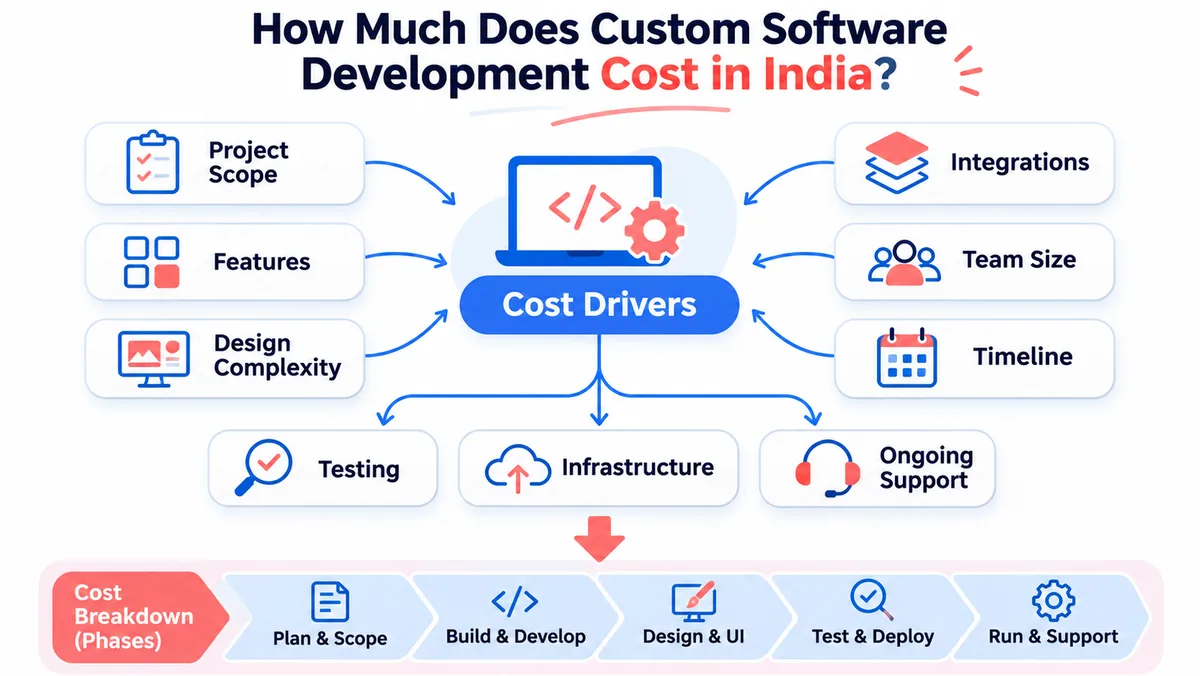
The biggest factor is scope. A project with one user role, basic dashboards and limited workflows will usually cost far less than software that handles multiple departments, permissions, reports and third-party integrations. Scope also includes business logic. Two apps may look similar on the surface but differ greatly in backend rules and process complexity.
Other major cost drivers are user experience design, technology choices, integrations, data migration, QA effort, security requirements, hosting, documentation and long-term maintenance. Timelines matter too. A tighter deadline can increase cost because it may require a larger team or parallel work streams.
How budgets compare by project size
Every project is priced on its own scope, so the clearest way to think about budget is by project size. Final numbers depend on requirements, architecture, integrations and how much planning has been done before development begins.
| Project type | Relative budget | What it may include |
|---|---|---|
| Small internal tool or MVP | Lowest of the three, suited to a focused first release | Core workflows, limited roles, basic UI and standard deployment |
| Mid-size custom web platform | Moderate, and grows with each role, report and integration | Multiple roles, dashboards, reports, admin panel and selected integrations |
| Complex platform or multi-system software | Highest, driven by integrations, security and scale | Advanced workflows, integrations, security layers, scale planning and ongoing support |
Where the budget usually goes
Custom software is not only coding. Discovery and scoping consume time because the team has to understand the process, define edge cases and translate business needs into technical logic. Design adds cost because user journeys, wireframes and screens must be shaped before the build becomes efficient.
Development is usually the largest portion, but quality assurance, deployment and post-launch support are also essential. If these are ignored during planning, the quoted cost may look low at first but rise later through change requests and rework.
Hidden costs buyers often miss
Some of the most important costs appear outside the main feature list. Examples include content migration, data cleanup, reporting logic, user training, role permissions, staging environments, server configuration, monitoring and support after launch. These items are common sources of budget drift.
Another hidden cost is unclear decision-making. If requirements keep changing because there is no agreed scope or approval process, the team spends more time revisiting work. That wastes both money and momentum.
- Third-party API or platform fees.
- Cloud infrastructure and backups.
- User acceptance testing and training time.
- Maintenance releases after launch.
- Scope expansion during the build.
How to control cost without hurting quality
The best way to manage budget is to reduce uncertainty. Start with a discovery phase, decide what must be in version one and what can wait, and prioritise workflows that deliver business value first. This makes the first release more achievable and reduces waste.
It also helps to use proven components where appropriate instead of custom-building every small function. However, the goal is not to make the quote look cheap. The goal is to invest in the right parts of the system and avoid expensive rework later.
- Define the business problem and the exact outcome the software should improve.
- Prioritise must-have features for version one.
- Approve wireframes or flow maps before full development starts.
- Identify integrations and data migration early.
- Plan a realistic testing, launch and support phase.
When custom software is worth the investment
Custom software makes sense when off-the-shelf tools force too many workarounds, when your workflow is central to business value, or when teams are losing time because data is spread across disconnected systems. It is also useful when you need stronger control over logic, reporting or user roles than generic tools can offer.
The right software should improve efficiency, visibility or customer experience enough to justify the investment. That is why requirements and process clarity matter more than rushing to estimate code alone.
Questions to ask before approving a budget
A software quote is only useful when you understand what is and is not included. Ask how the scope will be documented, how changes will be handled, which environments are included and what post-launch support looks like.
If you are comparing vendors, BlinkWorx custom software development services can help you plan the scope properly and align the build with your process, budget and rollout goals.
A phased roadmap also supports better cash flow management. Instead of tying the full budget to one long build cycle, the project can move in stages based on validated learning. This helps the business make more confident decisions about what to improve, automate or defer after the first release is in use.
Phasing is often the better commercial choice. Many software ideas begin with a large wish list, but only a portion of that list is essential for version one. By launching core workflows first, the business starts learning earlier and avoids investing too heavily in features that may later prove less important.
Should you build everything now or phase the project?
After development, testing becomes a major cost protector. It validates workflows, permissions, calculations and edge cases that can otherwise create operational issues later. Deployment, documentation and support complete the cycle. Businesses that budget for these phases up front usually experience fewer surprises than those that treat them as optional add-ons.
In many projects, discovery and planning produce the highest return on spend because they reduce ambiguity. Design then converts workflows into usable interfaces, which helps both stakeholders and developers align before more expensive implementation begins. Development consumes the largest portion of the budget, especially when user roles, business rules and integrations are extensive.
Cost by phase in more detail
The goal is not to maximise team size. It is to match the team to the project stage. In early discovery, strong scoping and architecture can save money later by preventing rework. In later stages, QA and deployment planning help avoid post-launch instability. A quote should therefore be evaluated in the context of team role coverage, not only headline price.
Software cost is influenced not only by the number of hours but also by who is involved. A lean MVP may need a product-minded developer, a designer and a QA resource. A more complex project may need a solution architect, backend developers, frontend developers, DevOps support and deeper QA effort. The wider the team, the more coordination is required, but that coordination may be necessary for quality and speed.
How team composition changes the budget
FAQ
Why do software companies ask for requirements before sharing a quote?
Because cost depends heavily on scope, roles, logic and integrations. Without requirements, any number is only a rough assumption. A more structured estimate reduces surprises and shows what is included, what is excluded and where the biggest budget drivers are likely to be.
Is custom software always more expensive than buying a ready-made tool?
Not always. Ready-made tools may seem cheaper at first, but they can become costly if teams need workarounds, separate subscriptions or manual reconciliations. Custom software is justified when the workflow is important enough that control, fit and efficiency create long-term value.
How can I reduce budget risk on a software project?
Start with discovery, prioritise version one carefully, clarify approval responsibilities and avoid changing the scope casually during development. Budget risk falls when business rules, data sources and user journeys are discussed early instead of being discovered halfway through the build.
Should I build web software, mobile software or both?
That depends on user behaviour. Many business systems begin as web applications because administration, reporting and process control are easier there. Mobile apps are useful when users need field access, frequent notifications or on-the-go workflows. The right choice affects cost and delivery speed.
What support should be planned after launch?
Plan for bug fixing, monitoring, security updates, minor improvements and user feedback rounds. Even a successful launch is the beginning of operational use, not the end of the software lifecycle. Factoring support into the budget helps the product remain stable and useful over time.
Key takeaways
- Custom software cost is driven by scope, integrations, complexity and long-term support, not by coding alone.
- A rough idea of budget is useful, but only detailed scoping produces a dependable budget.
- Discovery, wireframing and QA are budget necessities, not optional overhead.
- Version one should focus on core workflows and defer lower-priority features.
Planning your software budget
If you are evaluating custom software development cost in India, the best next step is to turn the project into clear modules, workflows and priorities. That gives you a more realistic budget and helps you spend on the areas that create actual business value. A thoughtful scope almost always saves more money than a rushed quote.
Talk to BlinkWorx
If you would like help choosing or building the right solution, contact BlinkWorx for a free consultation. You can also contact us here or message us on WhatsApp.