The SaaS product development process takes a business problem from early validation to a usable, secure cloud product and then improves it with real customer feedback. For founders, the practical sequence is to verify demand, define a focused MVP, select an appropriate architecture, build and test essential workflows, prepare onboarding and billing, and launch to a narrow audience. A strong launch is not a finish line. It is the point where product assumptions meet genuine customer behaviour.
You do not need a large feature catalogue to begin. You need a specific customer, a job worth solving and a product that performs that job reliably. The decisions below help you spend development effort where it creates the clearest learning.
Validate a SaaS problem before investing in development
A promising concept is not the same as demonstrated demand. Before commissioning screens or choosing a technology stack, describe the customer who faces the problem, what they do today and why the existing approach is inconvenient or expensive. Narrow audiences are useful because their workflows, language and buying criteria are easier to understand.
Interview users about existing behaviour
Ask potential customers to walk through the last time they encountered the problem. Look for repeated manual work, delayed decisions, duplicated data or frustrating handoffs. Avoid questions that invite polite praise, such as whether someone likes your imagined app. Instead, ask what they already use, who approves a purchase and what happens if the issue remains unresolved.
A founder building a scheduling product, for example, should learn how bookings are currently handled, where cancellations cause trouble and which team members need visibility. These are hypothetical prompts, not a claim about any particular business.
Test commitment rather than excitement
A landing page, clickable prototype or manually delivered pilot can uncover objections before a full build. Useful evidence includes a prospective buyer agreeing to a detailed pilot, sharing workflow requirements or discussing purchase conditions. A waiting list alone is weaker evidence unless those people remain engaged.
Capture what you learned in a concise problem statement: the target customer, painful job, current alternative, promised outcome and reason they might switch. This becomes the reference for every product decision that follows.
Turn the idea into a focused SaaS MVP roadmap
For teams without an in-house delivery function, BlinkWorx offers startup and SaaS development services covering early product planning and development support.
An MVP is the smallest usable version that delivers the main outcome and lets you observe whether customers value it. It is not a visually unfinished demonstration or an excuse to ignore basic security. The right scope depends on the workflow, data sensitivity and expectations of your first users.
Map one complete customer journey
Trace the essential path from discovering the product to signing up, completing a first meaningful task and receiving value. For a business reporting tool, that may involve creating an account, connecting an allowed data source, viewing a reliable report and sharing it. Features that do not support this path can often wait.
Keep a separate list for desirable later features. Advanced customisation, extensive dashboards and numerous integrations may be useful eventually, but adding them before customer validation makes the product harder to test and maintain.
Define an acceptance criterion for each workflow
Write observable outcomes, not vague labels. “User can invite a colleague with the correct access level” is more testable than “team collaboration.” Include expected behaviour for invalid inputs, slow connections and account recovery. This converts the MVP roadmap into a practical build and quality plan.
Choose an architecture that fits the product and customer
SaaS architecture decisions affect security, reliability, development speed and operating cost. Many business applications need authentication, data storage, background tasks, subscriptions, notifications, audit trails and support tools. They do not automatically require microservices or an elaborate cloud design at launch.
Understand tenant isolation and access controls
A SaaS product may serve separate organisations, often called tenants, on common infrastructure. Each organisation must only access data it is authorised to see. Logging in successfully is not sufficient protection against cross-tenant data exposure. The official AWS SaaS Lens guidance explains why isolation must be designed and verified across the system.
Choose shared or separate infrastructure based on customer expectations, the sensitivity of data, regulatory needs and operating complexity. Document who can see what, how permissions are enforced and how customer data can be exported or removed.
Prioritise maintainable foundations
For the first release, favour technologies that the delivery team can support confidently. Plan for secure authentication, backups, monitoring, automated deployment and a recovery procedure. If customers operate worldwide, consider time zones, accessibility, localisation, payment coverage and regional data obligations early enough to avoid disruptive redesigns.
Scalability matters, but premature complexity can slow the launch. Start with an architecture that handles expected use safely and can be expanded when real demand justifies it.
Build, test and prepare the first customer experience
Product development works best in short, reviewable increments. Build the core customer journey first, demonstrate it with realistic sample data and obtain feedback while changes are still manageable. A working screen is only one part of a usable SaaS product; permissions, error handling and data integrity are equally important.
Make quality checks part of each release
Test user permissions, key workflows, browser and device behaviour, failed payment responses, email delivery, imports, exports and account cancellation. Include tests for unexpected inputs and cross-tenant data access where relevant. Security review should cover secrets handling, dependency updates, access logs and incident response.
Invite pilot customers to perform real tasks without a guided demonstration. Watch where they hesitate, misunderstand labels or abandon a flow. Their behaviour often reveals more than a long feature request list.
Design onboarding and support before launch
A confusing setup experience can make a useful product feel broken. Provide clear account activation, a short setup sequence, meaningful empty states and a way to contact support. For a complex business product, consider guided setup or assisted migration. Explain what data customers must supply and which integrations are optional.
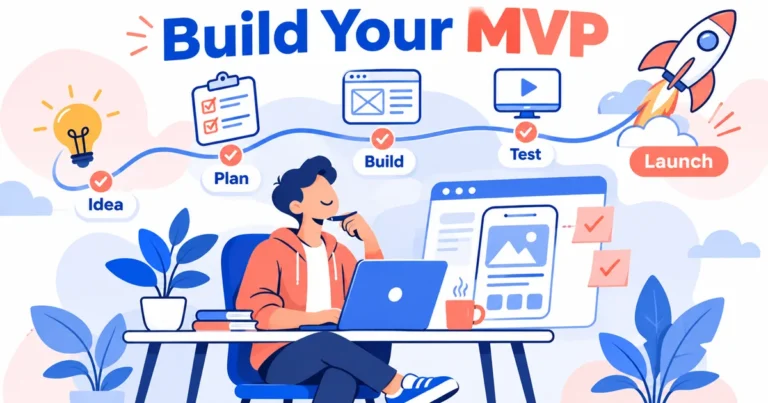
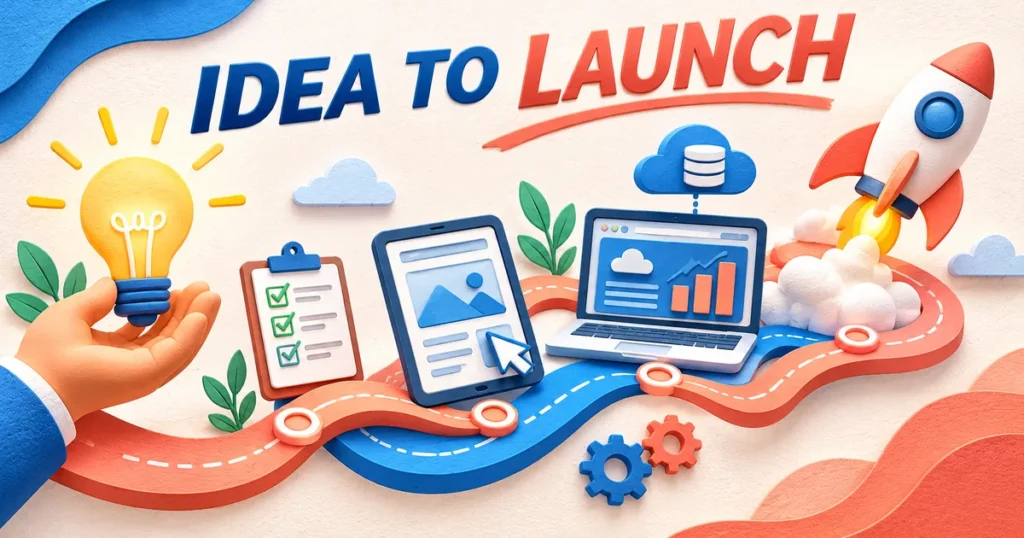
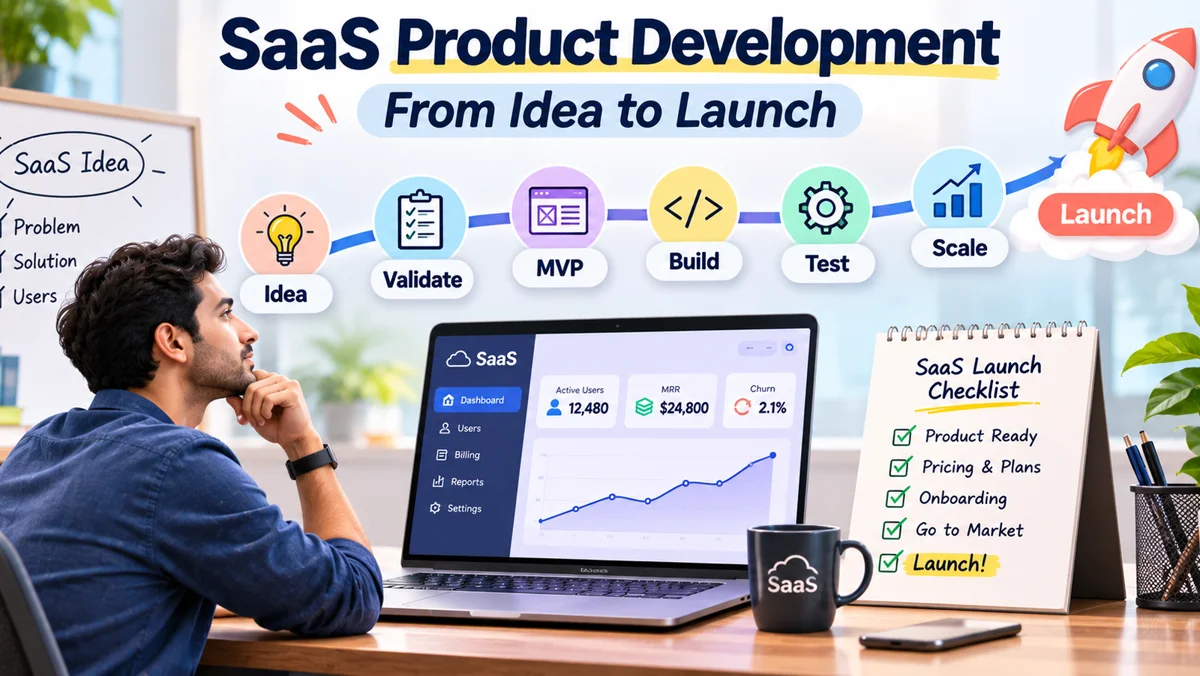
The illustration below shows the journey as connected stages. In practice, development often loops between testing, customer feedback and revisions rather than moving through a perfectly straight line.
Prepare pricing, billing and a controlled SaaS launch
Pricing should reflect the value customers receive and the cost of providing service. Possible models include per-user subscriptions, usage-based charges or plans with different capabilities. There is no universally best model. Interview buyers about purchasing processes, budgeting expectations and what they consider a fair unit of value.
Before taking payments, confirm that invoices, renewals, taxes, failed-payment handling, cancellations and refund terms work for the markets you serve. Payment providers and legal requirements vary by country, so avoid assuming one checkout flow suits every region.
A founder-friendly launch checklist
- The principal customer journey works without developer assistance.
- Account creation, sign-in, permissions and recovery have been tested.
- Customer records are backed up and isolated appropriately.
- Subscription terms, invoices and cancellation instructions are visible.
- Monitoring, support contact and incident escalation are in place.
- A small launch audience and a feedback collection method are defined.
Release to a manageable group first. Communicate what is available, what is still planned and how customers can report problems. A launch campaign cannot compensate for a product that users cannot activate or trust.
Measure activation, retention and product learning after release
Traffic and sign-ups show interest, but they do not prove the product is useful. Track whether new accounts complete the first valuable action, return to perform it again and continue using the service. For paid SaaS, examine conversion, renewal behaviour, cancellations and the reasons customers contact support.
A useful analytics event should represent meaningful behaviour. “Project created” may matter more than “dashboard viewed” for a project-management product. Avoid collecting unnecessary personal information merely because a tracking platform makes it possible.
Decide what to improve using customer signals
Group feedback by the outcome customers are trying to achieve. A repeated onboarding failure deserves attention before a rarely requested cosmetic feature. When users ask for a new integration, learn which job it would enable and whether a simpler workflow could solve the same need.
The AWS SaaS design principles also emphasise measuring tenant activity and supporting repeatable onboarding. Combine these operational signals with user interviews so improvements address both customer experience and service reliability.
Frequently asked questions about building a SaaS product
How long does the SaaS product development process take?
The timeline depends on product complexity, available developers, integrations, security needs and how clearly the customer workflow is understood. A narrow MVP can move faster than an enterprise platform, but neither should skip validation or testing. Plan around measurable milestones and revise the schedule when new evidence changes the scope.
Should a founder build an MVP before finding paying customers?
A founder should validate the problem and test willingness to commit before investing heavily. A prototype, manual pilot or discovery project may provide sufficient learning at first. Build an MVP when users need an actual working solution to evaluate the value, reliability and fit of the product.
Is multi-tenant architecture mandatory for SaaS?
No single deployment model fits every SaaS business. Some products share infrastructure between customer organisations, while others use isolated environments or a hybrid approach. The important requirement is appropriate separation of customer data and access. Your architecture should reflect technical, security, commercial and regulatory considerations.
What should a SaaS launch include besides the application?
Customers also need onboarding instructions, support contact details, clear subscription terms, a privacy notice and reliable billing where applicable. The team needs monitoring, backup and recovery processes. A limited initial rollout helps reveal usability and operational issues before a larger marketing push creates more demand.
Can a SaaS product change direction after launch?
Yes. Early adoption and retention data may show that customers value a different feature or audience than originally expected. Make changes based on repeated evidence rather than isolated suggestions. Preserve data access, communicate material changes clearly and avoid breaking the workflow existing customers already depend on.
Build a SaaS business that is ready to learn and grow
The strongest SaaS product development process is a continuous cycle of validating a problem, shipping a dependable solution and learning from customer behaviour. Founders should resist measuring success only by completed features. A smaller product that solves one valuable job reliably can give a business a stronger foundation than an elaborate release that people struggle to use.
Key takeaways for SaaS founders
- Start with evidence of a repeated customer problem, not a long feature list.
- Scope the MVP around one complete journey from sign-up to value.
- Treat tenant isolation, permissions and recovery as product requirements.
- Prepare onboarding, billing and customer support before public launch.
- Use activation, retention and support feedback to guide the roadmap.
If you are planning a new platform or improving an existing product, explore BlinkWorx’s startup and SaaS product development services to discuss product strategy, MVP engineering and launch readiness. You can also contact the team or start a WhatsApp conversation about the product you want to build.