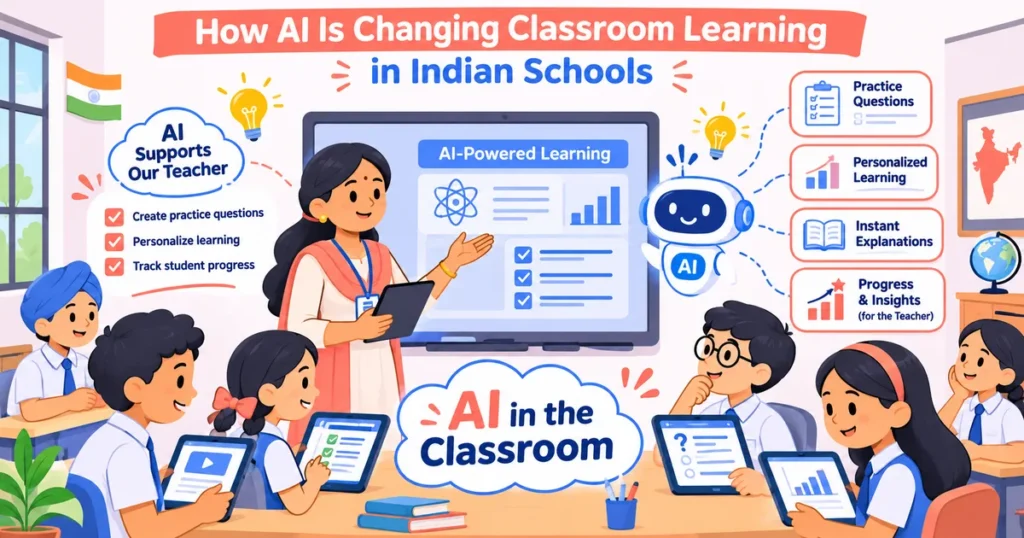
AI in education in India is already changing classroom learning, though rarely in the dramatic way headlines suggest. Its real impact today is quieter: teachers using AI to plan lessons and build practice questions faster, students getting extra practice matched to where they struggle, and schools spotting learning gaps earlier. Used well, it gives teachers back time and gives students more personal support. Used carelessly, it can mislead students, weaken real learning and put children’s data at risk. This guide covers where AI helps, where it does not, and how a school can introduce it safely.
What AI in education in India looks like in the classroom
Most of the useful AI in Indian schools sits behind the teacher rather than in front of the class. A science teacher asks an AI assistant for five ways to explain photosynthesis to a Class 7 group with mixed English levels, then picks the one that suits her students. A maths department generates a set of practice problems at three difficulty levels in minutes instead of an evening. An English teacher gets a first-pass summary of common grammar errors across forty essays before marking them properly.
On the student side, AI shows up as adaptive practice, where the next question depends on how the last one went, and as tools that explain a concept again in simpler words or a different language. In every useful case, the AI supports a decision a teacher or student still makes. That distinction matters more than any feature list.
Where AI helps teachers most
Teachers in India often handle large classes, several sections and heavy administrative work. AI is most valuable where it removes repetitive preparation without taking over judgement.
Lesson planning and teaching resources
AI can draft a lesson outline, suggest an opening activity, propose real-life examples relevant to Indian students, or turn a textbook chapter into a short revision sheet. The teacher’s role is to check accuracy, adjust the level and match it to the syllabus. A good habit is to treat every AI draft as a first draft from a capable but inexperienced assistant.
Practice questions and quick checks
Creating varied practice is time-consuming. AI can produce multiple versions of a question, worksheets at different difficulty levels, or a five-question exit check for the end of a period. This makes it easier to give weaker students more practice and stronger students more challenge in the same class.
Feedback on written work
AI can highlight patterns across a set of answers, such as a misconception many students share, so the teacher knows what to re-teach. It should not assign final marks on its own. Teachers know context that an AI tool does not, including a student’s effort, circumstances and progress over the term.
Language support
In multilingual classrooms, AI can help a teacher prepare an explanation in a regional language or simplify vocabulary for students still building English fluency. Translations of technical subjects still need checking by someone who knows both the language and the subject.
How AI supports students
For students, the main benefit is more personal practice and help at the moment they are stuck. Adaptive practice tools adjust difficulty based on answers, so a student who keeps missing fraction problems gets more of them, with hints, instead of moving on. Students who are shy about asking in class can ask an AI tutor to explain a step again.
AI can also improve access. Text-to-speech, captions and simplified explanations can help students with reading difficulties or learning disabilities take part more fully. These benefits depend on the school choosing tools with care and teaching students how to use them, including how to question an answer that looks wrong.
What AI should not do in a classroom
Clear limits protect both learning and trust. Before introducing any tool, agree as a school on what it will not be used for.
- It should not replace the teacher. Explanation, encouragement, discipline and noticing a struggling child remain human work.
- It should not make final assessment decisions. Marks, promotion and remarks on report cards need a teacher’s judgement.
- It should not do students’ thinking for them. If AI writes the essay or solves the homework, the student practises nothing. Design tasks that show the working, not only the answer.
- It should not be trusted blindly. AI tools can state wrong facts confidently. Students need to learn to check answers against textbooks and teachers.
- Young children should not use open AI chat tools unsupervised. For primary classes, AI is best used by teachers to prepare material, not handed to children directly.
Curriculum and policy context in India
AI is also becoming something students learn about, not just learn with. The National Education Policy 2020 puts weight on coding, computational thinking and digital skills from the middle stage of school. CBSE has published an Artificial Intelligence curriculum for Classes IX, XI and XII, with teacher and facilitator guides, available on the CBSE Academic AI curriculum page.
For schools, this creates two related goals: using AI to improve teaching, and teaching students to understand and use AI responsibly. The second includes knowing how AI tools reach answers, where they fail, and why human judgement still matters. A school that models careful use in its own classrooms teaches that lesson better than any single chapter.
Student data, privacy and the DPDP Act
Any AI tool that handles student information brings privacy duties. Under India’s Digital Personal Data Protection Act, 2023, a child is anyone under 18. Before processing a child’s personal data, an organisation must obtain verifiable consent from a parent or lawful guardian. The Act also prohibits tracking, behavioural monitoring and targeted advertising directed at children, and processing likely to harm a child’s well-being. It allows the government to exempt certain organisations or purposes from some of these requirements, so check the current rules with a legal adviser.
In practice, before adopting any AI tool, a school should ask the vendor:
- What student data does the tool collect, and why is each item needed?
- Where is the data stored, who can access it, and how long is it kept?
- Is student data used to train the vendor’s AI models?
- How does the school get parental consent, and how can a parent withdraw it?
- Can student accounts run without names, photos or other identifiable details where those are not needed?
If a vendor cannot answer these clearly, that is reason enough to wait.
A practical rollout plan for schools
Schools that get value from AI usually start small, with teachers, and expand only after they see results. A one-term pilot works well.
| Stage | What to do | Who leads it |
|---|---|---|
| 1. Set the purpose | Pick one or two problems, such as preparation time or remedial practice in one subject | Principal and academic coordinator |
| 2. Write simple rules | Agree what AI may and may not be used for, by teachers and by students | Leadership with senior teachers |
| 3. Check the tool | Review data handling, consent and accuracy before any student uses it | Administration and IT |
| 4. Train a small group | Start with a few willing teachers, not the whole staff | Academic coordinator |
| 5. Pilot for one term | Use it in a few classes and collect teacher and student feedback | Pilot teachers |
| 6. Review and decide | Expand, adjust or stop based on what the pilot showed | Leadership |
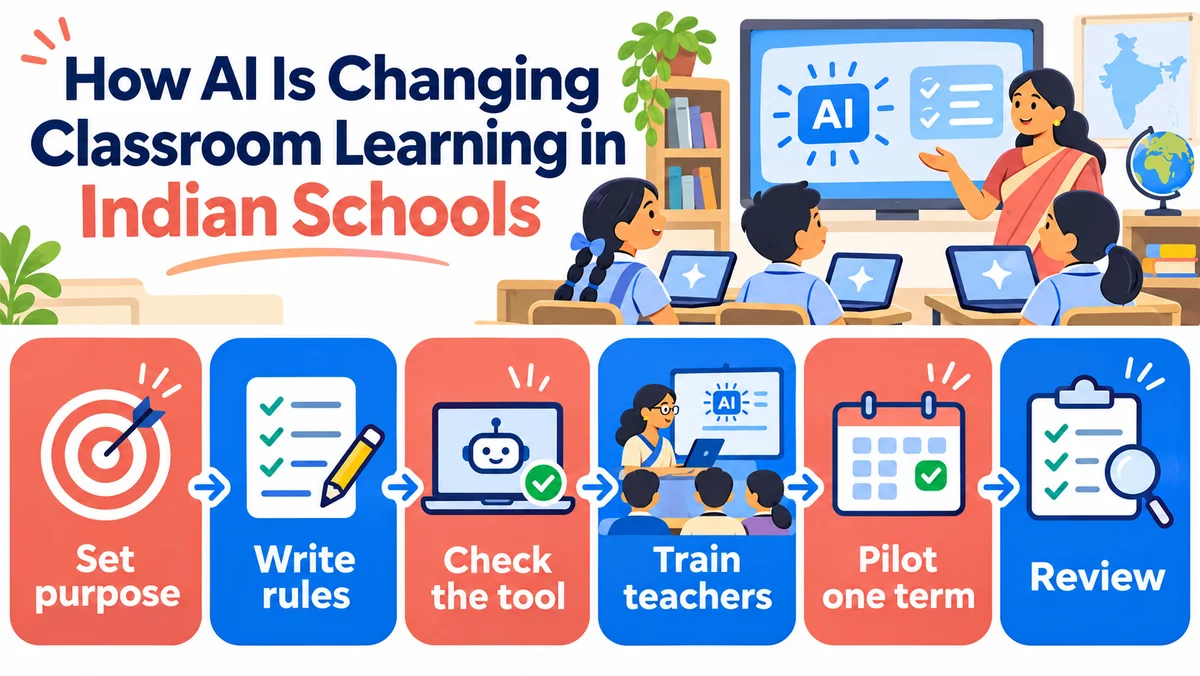
Keep parents informed throughout. A short note explaining what the school is trying, why, and how student data is protected prevents rumours and builds trust.
How to tell whether AI is helping
Judge the pilot by learning and teaching outcomes, not by how much the tool was used. Useful signals include:
- Teachers report spending less time on routine preparation and more on teaching.
- Students who were falling behind in the pilot subject show improvement in class tests.
- Students can explain their working, not just give correct answers.
- Teachers trust the tool’s output enough to use it, but still catch its mistakes.
Watch for warning signs too: homework that looks too polished, students who cannot answer the same questions without the tool, or teachers quietly avoiding it. These are reasons to adjust the rules, not to give up on the idea entirely.
Platforms that bring classes, assessments and progress data together make this review easier. AcadifyLab, the learning platform built by BlinkWorx, combines live and recorded classes, assessments and student analytics, with AI-powered learner help and teaching insights on eligible plans. Schools whose main challenge is administration rather than teaching can start with the benefits of a school ERP instead.
Key takeaways
- AI in Indian classrooms works best as a teacher’s assistant: planning, practice and spotting learning gaps.
- Marks, feedback and care for students stay with teachers.
- Design tasks so students show their thinking, not just answers AI could produce.
- The DPDP Act requires verifiable parental consent for children’s data, so check every vendor’s data practices first.
- Start with a one-term pilot, a few teachers and clear rules.
Frequently asked questions
Will AI replace teachers in Indian schools?
No. AI can speed up preparation, generate practice and highlight patterns in student work, but it cannot build relationships, manage a classroom, motivate a reluctant student or judge a child’s progress in context. The schools getting the most from AI use it to give teachers more time for the parts of teaching only people can do.
Is it safe for students to use AI tools?
It can be, with the right tool and rules. Choose tools built for education, check how they handle student data, get parental consent where required, and supervise use, especially for younger children. Teach students that AI can be wrong and that they should check important answers against textbooks or teachers before relying on them.
How can schools stop students using AI to cheat?
Change the task as well as the rules. Ask students to show working, explain answers aloud, write drafts in class, or reflect on how they reached a conclusion. Make clear when AI is allowed, such as for brainstorming, and when it is not. Detection tools alone are unreliable and can wrongly accuse honest students.
Do schools need expensive technology to start using AI?
Not to begin. Many useful steps, such as teachers using AI to draft lesson plans or practice questions, need only a computer and an internet connection. Bigger investments, such as adaptive learning platforms for students, make sense once a small pilot has shown which problems AI actually solves for your school.
Does CBSE teach Artificial Intelligence as a subject?
Yes. CBSE has published an Artificial Intelligence curriculum for Classes IX, XI and XII, along with facilitator guides for teachers. Schools should check the CBSE Academic website for the current curriculum, eligibility and resources, as these are updated from time to time.
Starting small with AI in your school
The schools that gain most from AI in education in India are rarely the ones that adopt the most tools. They choose one real classroom problem, set clear rules, protect student data and let teachers lead. Start with a single subject and a single term, and let what you learn decide the next step.
Talk to BlinkWorx
If you are planning online learning, assessments or AI-supported teaching, explore AcadifyLab LMS or book a free consultation. You can also contact our team or message us on WhatsApp.