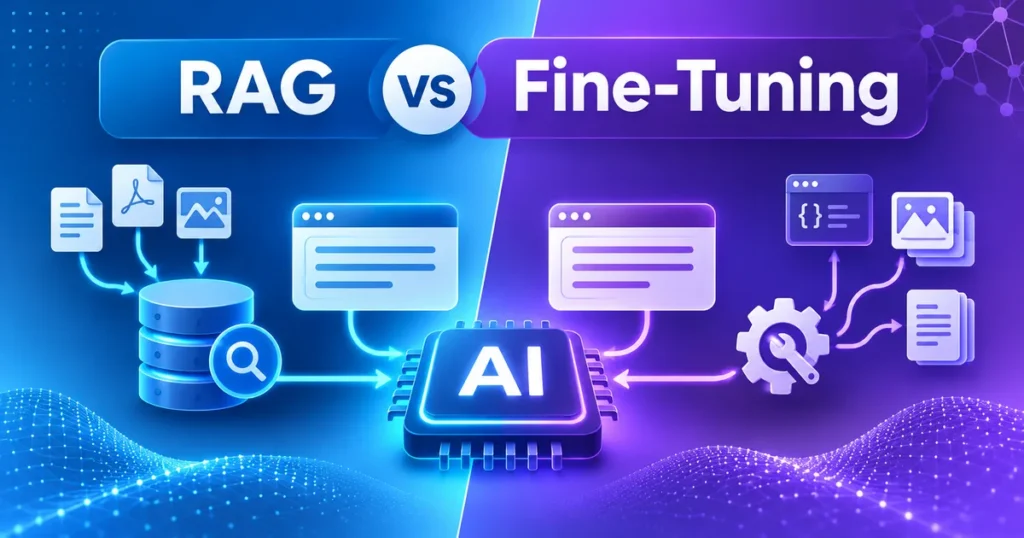
RAG vs fine-tuning is a choice between giving an AI model access to information at answer time and changing the model’s learned behaviour through additional training. Retrieval-augmented generation, or RAG, usually fits assistants that need current company documents and traceable answers. Fine-tuning is more suitable when the problem is consistent output format, specialised language or task behaviour. They are not rivals in every project; some applications combine both. Choose based on the failure you need to fix, not on which technique sounds more advanced.
The difference in plain English
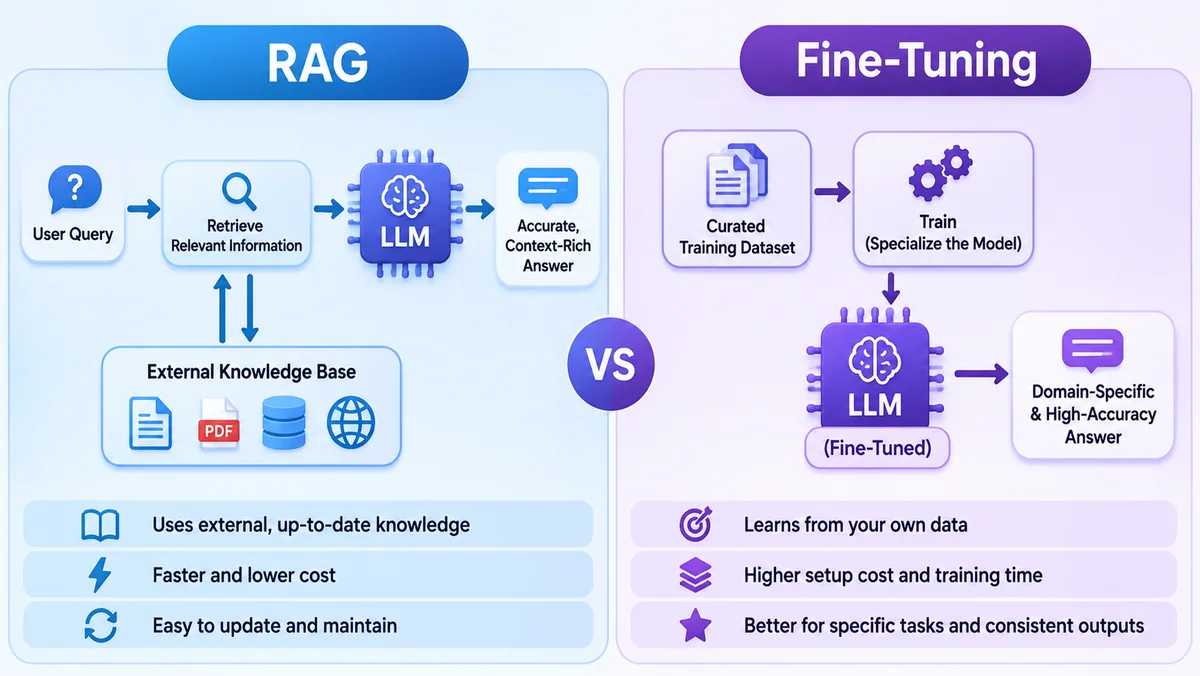
Imagine an employee asks an AI assistant about your latest refund policy. A RAG system first searches approved policy content and supplies relevant passages to a model, which then answers using that context. If the policy changes, the content index can be updated without retraining the base model.
Fine-tuning works differently. You prepare examples of desired inputs and outputs and train an eligible model so its responses follow patterns more reliably. That may improve structure, tone or task handling, but it does not create a dependable live connection to your changing policy documents.
A useful analogy is an open-book exam versus specialist practice. RAG brings the reference materials into the room. Fine-tuning teaches a model to perform a task in a preferred way. Neither removes the need to test outputs.
How retrieval-augmented generation works
A typical RAG workflow collects approved documents, cleans them, splits content into manageable sections and indexes it for retrieval. When a user asks a question, a search process finds potentially relevant passages. Those passages and the question are sent to a language model to create an answer.
Retrieval is not automatically reliable. Poor document structure, stale copies, missing access permissions or irrelevant passages can still cause weak answers. Good systems evaluate retrieval quality separately from answer quality. They may show source links and state when the available information is insufficient.
RAG can be particularly useful for support centres, policy assistants, internal knowledge tools and product documentation. Access controls are essential: a user should not receive content simply because it exists somewhere in the organisation’s document store.
What fine-tuning changes and what it does not
Fine-tuning modifies model behaviour through additional training examples. Common goals include reliably returning a structured schema, using industry terminology, matching an approved conversational style or handling a specialised classification task. It may reduce the amount of instruction needed in each request for some tasks.
It should not be treated as a document repository. A model tuned on old material may still produce outdated answers, and learned behaviour does not ensure perfect factual recall. Fine-tuning also introduces data preparation, evaluation and version-management work. Training data quality matters more than raw example volume.
Before paying for tuning, test whether a strong prompt, examples in the prompt, structured output controls or a retrieval workflow already solves the problem. The simplest reliable approach is often easier to maintain.
Compare cost, freshness, accuracy and operations
Business leaders should compare total implementation effort, not only model API charges. RAG requires document ingestion, retrieval infrastructure, access control, monitoring and refresh processes. Fine-tuning requires curated examples, model training support, evaluation sets and periodic updates. Each creates different ongoing work.
If business knowledge changes frequently, retrieval usually offers a more direct update path. If a task is stable but the model consistently misses format or style requirements, fine-tuning may offer value. Both approaches can still hallucinate, expose data if configured poorly, or fail on ambiguous questions.
Latency depends on architecture. Retrieval adds a search step, while a fine-tuned model may respond without that lookup for certain tasks. However, a tuned model can be larger or more costly, and a complex RAG pipeline can be optimised. Test your actual workload before assuming one option is faster.
Use a decision matrix for your use case
Start by identifying what is going wrong. If the assistant cannot answer from an employee handbook, product catalogue or policy library, use retrieval and source management first. If it knows the facts but repeatedly fails to produce the required JSON structure or domain-specific phrasing, consider prompts and fine-tuning.
If answers need both fresh facts and a consistent specialised format, a hybrid architecture may be appropriate. Retrieve approved sources, then let the model generate within a controlled schema. Fine-tuning can be added only if repeated evaluation shows a clear improvement.
Document risk changes the decision. In high-stakes support, include review mechanisms, escalation rules and limitations regardless of model technique. Neither RAG nor tuning converts an AI system into an infallible expert.
Evaluation before you deploy to users
Prepare a test set of real questions, expected source material and acceptable answer behaviour. Include easy questions, outdated-document conflicts, missing information and attempts to access restricted content. Measure whether the system retrieved the right evidence, whether the response used it correctly and whether the assistant declined to guess when evidence was insufficient.
For fine-tuning, evaluate consistency on examples excluded from training. Check whether improvements in one category reduce performance elsewhere. Version the data and model, record prompt changes and test again after major knowledge-base updates.
Human review remains useful. Subject-matter experts can flag subtle business errors that an automated score misses. An evaluation process is not a final checkbox but an ongoing safeguard as documents, models and user questions change.
A practical implementation roadmap
Begin with the lowest-complexity baseline: a clear system prompt, approved content and a small set of representative questions. For knowledge-heavy applications, pilot retrieval with access control and citations. For behaviour-heavy tasks, test structured prompts and few-shot examples. Use the results to decide whether additional investment is justified.
Design operational ownership early. Somebody must approve source documents, handle deletion requests, monitor incorrect answers and coordinate updates. Treat confidential data and customer information according to your organisation’s security and privacy obligations.
Businesses evaluating custom AI applications can use BlinkWorx AI development support to translate the use case into architecture, testing criteria and a staged implementation rather than committing to an unnecessarily complex model strategy.
Explore related services: AI development at BlinkWorx
Data governance can be the deciding factor. A company knowledge assistant may need to respect document-level permissions, delete outdated files promptly and keep customer records out of model-training datasets. RAG offers a clear place to enforce retrieval permissions, but only if identity, search filtering and source handling are implemented correctly. Fine-tuning introduces a different set of questions about the provenance, consent and permitted uses of training examples.
A practical pilot can compare three versions on the same evaluation set: a well-written baseline prompt, the baseline with retrieval, and an eligible tuned model. Record quality, latency, cost per meaningful task and human-review effort. The goal is not to award the most technically sophisticated architecture. It is to select the approach that meets the business’s real quality and maintenance requirements.
If you are building a support assistant, ask what should happen when two sources disagree. The system may need document priority rules, effective dates and a clear refusal to answer when no authoritative source is available. Better search alone will not solve conflicts in policy ownership. Addressing these organisational issues can matter more than model choice.
Frequently asked questions
Is RAG always cheaper than fine-tuning?
Not necessarily. RAG can incur indexing, search, infrastructure and ongoing retrieval costs, while tuning requires data preparation, training and model management. The lower-cost option depends on traffic, document volume, task complexity and maintenance needs. Compare total ownership cost through a small pilot.
Does fine-tuning make an AI model know company policies?
It can expose a model to examples, but it is not a dependable way to keep changing policies current or cite their sources. For policy questions, retrieval from approved, versioned documents is usually the more direct foundation. Test answers carefully and provide escalation where needed.
Can RAG and fine-tuning be combined?
Yes. A system may retrieve current approved information and use a fine-tuned model to follow particular formatting or task conventions. However, the combined approach adds complexity. First establish that retrieval and prompting alone do not adequately meet the required quality standard.
What is a vector database in RAG?
A vector database can store numerical representations of content and support similarity search to find potentially relevant passages. It is one possible retrieval component, not a complete RAG system. Document permissions, data cleaning, ranking, prompt design and evaluation still determine the quality of the final response.
Which method is better for a customer support chatbot?
For support based on changing help articles, policies and product documentation, RAG is often a sensible starting point. Fine-tuning may help if responses must follow stable specialised patterns. In either case, include human handoff, knowledge ownership, privacy controls and regular quality testing.
Key takeaways
- Use RAG for dynamic approved knowledge and source-grounded responses.
- Consider fine-tuning for repeated behavioural or formatting problems.
- Evaluate retrieval and generation separately before adding complexity.
- Access controls and human escalation remain essential.
Choosing between RAG and fine-tuning
In the RAG vs fine-tuning decision, start with the problem rather than the technique. If your AI needs current, approved information and answers you can trace back to a source, begin with RAG. If it already has the right knowledge but responds in the wrong format or tone, fine-tuning may help. Many business systems start with RAG and add fine-tuning only when testing shows a clear, repeated gap.
Contact BlinkWorx for a free consultation about AI development services. You can also message us on WhatsApp or contact our team.
Further reading: AWS: RAG and fine-tuning options.