
The Digital Personal Data Protection (DPDP) Act changes how Indian schools should think about student information. For school leaders asking what the DPDP Act means for schools, the practical answer is to collect only necessary digital personal data, explain its use, protect it, and prepare to respect parents’ and students’ rights. Special rules address children’s information. Importantly, the law has a phased commencement, so not every obligation is already enforceable. Schools should prepare now rather than wait for a data incident.
Why Student Data Protection Is a School Leadership Issue
A school may hold admission forms, photographs, attendance, assessment results, contact details, transport routes, health-related notes and fee records. Much of this information can identify a student or family. A spreadsheet shared outside the admissions office or an outdated account with broad access can expose far more than a single record.
Data protection is therefore not simply an IT department concern. Principals decide why information is needed, admissions teams collect it, teachers use it and technology vendors store or transmit it. Good decisions at each point make the school safer and help families understand how their information is handled.
Digital personal data includes information collected online and information originally collected on paper and later digitised. Schools should map both, including documents scanned during admission and records uploaded into a school management platform.
What the DPDP Act Requires and When It Takes Effect
India’s Digital Personal Data Protection Act, 2023 and the Digital Personal Data Protection Rules, 2025 establish the framework for processing digital personal data. The official commencement notification staggers implementation. Some institutional provisions began in November 2025; other provisions commence after one year, while the main operational duties, including the children’s data provisions, are scheduled for eighteen months after publication, in May 2027.
This distinction matters. A school should not tell parents that every duty under the Act is already in force. Nor should it treat the later commencement date as permission to postpone privacy work. Existing contractual, education-sector and other applicable legal responsibilities still matter.
The Act generally uses the term “data fiduciary” for an entity determining why and how personal data is processed. A school may perform that role for student records; a technology provider may act as a data processor when handling information on the school’s behalf. Actual roles depend on the arrangement.
Official reference: DPDP Act, 2023 (MeitY)
Children’s Data, Parent Consent and School Exceptions
Understanding the under-eighteen rule
Under the Act, a child means a person who has not completed eighteen years. Section 9 provides for verifiable parental consent before processing children’s personal data, subject to specified exemptions. It also addresses processing likely to harm a child’s well-being and restricts tracking, behavioural monitoring and targeted advertising directed at children.
However, schools should avoid the blanket statement that parental consent is required for every routine educational activity without exception. The notified Rules provide limited exemptions for educational institutions for specified purposes and conditions, including certain educational and safety-related processing. Their scope must be checked carefully against the actual activity.
Make consent understandable
For processing that requires consent, explain what information is requested, the purpose, who will use it and how parents can make a request. A generic checkbox buried in a long admission form is not a sound substitute for a clear, lawful process. Keep evidence of consent where required and plan for withdrawal requests.
For example, attendance records, school communications, public photographs, promotional videos and third-party learning applications may involve different purposes and legal considerations. Do not assume one consent statement automatically covers them all.
Which School Records Need the Most Care?
The right approach is to classify records by sensitivity, purpose, audience and retention need. A public prospectus is different from a child’s emergency contact information. A teacher may need to see class attendance but not the entire school’s fee or medical records.
| Record | Typical purpose | Practical safeguard |
|---|---|---|
| Admissions documents | Eligibility and enrolment | Restricted admissions access |
| Attendance and grades | Teaching and reporting | Role-based teacher access |
| Parent contact details | Essential communication | Limit exports and sharing |
| Health or support notes | Student care | Need-to-know access |
| Photographs and videos | School activities or publicity | Separate purpose review |
| Transport information | Student pickup and safety | Limit location visibility |
Keep a data inventory that names each system, record category, purpose, access group and deletion approach. Include shared drives, messaging groups, email attachments, biometric systems if used, and archived databases. Forgotten copies can be harder to protect than the main school ERP.
A Practical DPDP Preparation Checklist for Schools
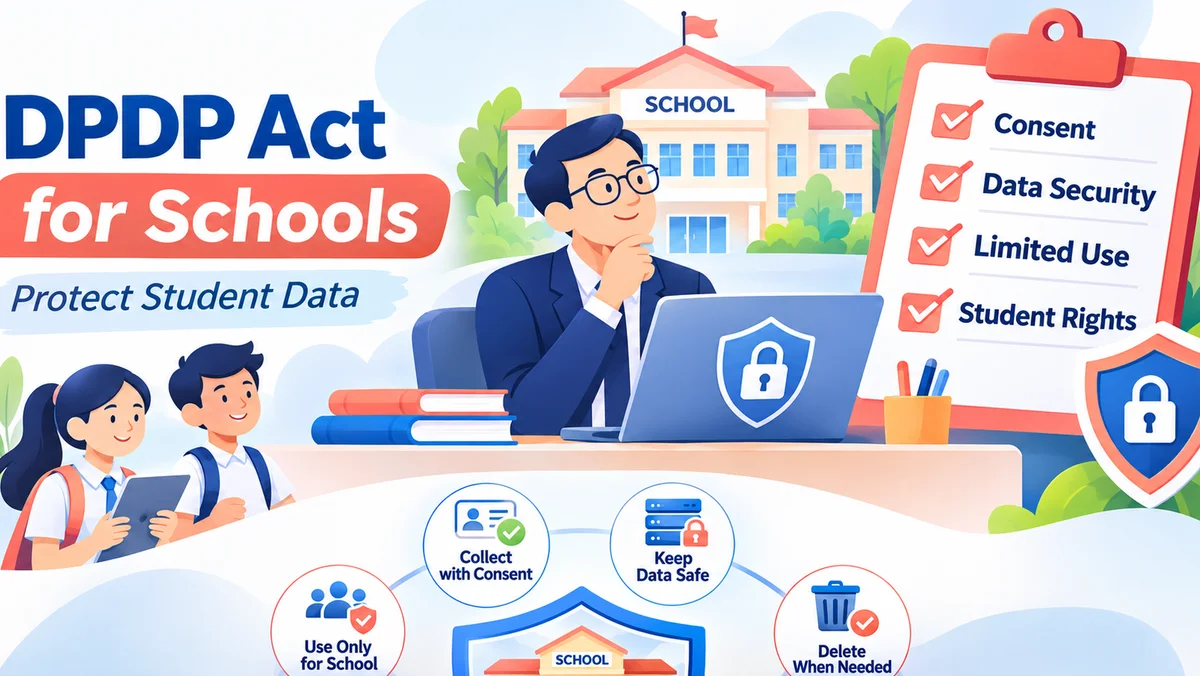
A manageable plan starts with ordinary school workflows. The checklist below is intended for administrators, not just technical teams. It is preparation guidance, not a legal certification.
- List where student and parent information enters the school, from enquiry forms to transport registration.
- Explain collection purposes in simple language at the point where information is requested.
- Separate routine educational processing from optional publicity and marketing activities.
- Check whether parental consent or a narrowly defined exemption applies to each child-data activity.
- Restrict access by job role and promptly disable accounts when staff leave.
- Use strong authentication, secure backups, encryption where appropriate and tested recovery procedures.
- Set retention and deletion rules that account for applicable education and legal requirements.
- Create a clear channel for parent requests, corrections and privacy complaints.
- Document how the school will investigate and respond to a suspected data breach.
Make this a recurring administrative exercise, especially when launching a new app, opening a campus, changing admission forms or appointing a technology vendor. Privacy decisions made during procurement are often easier to implement than fixes after rollout.
How School ERP Systems and Vendors Affect Compliance
A school ERP can centralise records and reduce uncontrolled paper and spreadsheet sharing, but software alone does not make an institution compliant. The school still needs suitable purposes, lawful processing, notices, access rules and retention decisions. The provider should be able to explain how its service supports those decisions.
Ask vendors where information is hosted, which staff can access it, whether access logs are available, how backups work, how incidents are reported, and what happens to data when the contract ends. Also ask about subcontractors, exports, deletion, role-based permissions and authentication options.
Avoid claims such as “DPDP certified” unless there is a specific, verifiable certification scheme and evidence for the claim. Instead, request a demonstration of relevant security and administrative controls.
Schools exploring a more organised approach to student records can examine eSchoolApp school ERP solutions and ask which privacy and access controls are available for their intended deployment. Confirm product capabilities directly rather than assuming every safeguard is included.
Responding to Parent Requests and Data Incidents
Parents may ask what information the school holds, whether a record can be corrected, or why a third-party app needs a particular detail. Prepare a process to authenticate requests, find the relevant records, assess applicable rights and exemptions, and respond consistently. Some rights and procedures become operative according to the notified schedule.
For an incident, staff should know whom to contact immediately. Preserve evidence, contain unauthorised access, identify affected systems, involve the technology provider and seek appropriate legal guidance on notification obligations. A lost laptop, accidentally shared spreadsheet or compromised messaging account can each require a different response.
The notified framework includes breach-intimation duties and prescribed details, but the exact obligations and timelines should be checked against the provisions in force when an incident occurs. A school should not invent a universal reporting deadline for every event.
A short staff exercise can be useful: what happens if an admissions spreadsheet is emailed to the wrong recipient? Who can disable access, trace the file and contact the right people? The answer should be operational rather than only written in a policy document.
Common Mistakes School Administrators Can Avoid
The most common weakness is collecting information because a form has always requested it. Ask whether each field is needed for the stated purpose. Another weakness is sharing complete records in staff groups when a limited extract would be sufficient. Convenience can quietly create long-lived copies.
Do not publish student photographs, names or achievements without checking the appropriate legal basis and school policy. Do not assume that using a popular cloud provider automatically resolves the school’s responsibilities. And do not treat a privacy policy copied from another institution as a substitute for describing your own practices.
Finally, avoid confusing a secure website with a secure data operation. HTTPS is useful, but access permissions, staff training, retention, backups, vendor arrangements and incident handling matter just as much.
Key Takeaways for School Leaders
- The DPDP framework is being introduced in phases; distinguish current requirements from upcoming duties.
- Children’s information needs special care, with specific exemptions that must be interpreted narrowly.
- Map admissions, academic, transport, communication and media records across every system.
- Use access controls, documented retention, secure vendors and a workable incident process.
- Treat a school ERP as a supporting tool, not a replacement for governance and legal advice.
Frequently Asked Questions About the DPDP Act in Schools
Does the DPDP Act apply to private schools in India?
The Act can apply to digital personal data processed by private schools when the statutory conditions are met. The institution’s legal role depends on how it determines the purposes and means of processing. Its obligations must be assessed alongside the phased commencement dates, relevant exemptions and other applicable laws.
Do schools need parental consent for every student record?
Not necessarily. The Act provides for verifiable parental consent for children’s data, but the notified Rules specify exemptions for certain educational institution activities and purposes. Schools should evaluate each processing activity rather than using one rule for attendance, safety, optional apps and promotional photographs.
Can schools share student data with an ERP provider?
A school may engage a technology provider to process data on its behalf under appropriate arrangements, but it remains important to establish a lawful basis, purpose limitations and security safeguards. Review the vendor contract, access rights, subcontractors, deletion arrangements and incident procedures before transferring records.
What should a school do after a student data leak?
First contain the incident, preserve evidence and identify which information and systems were affected. Involve the relevant technical provider and legal adviser, then assess any notification obligations applicable at that time. Document the response and correct the underlying weakness. Do not rely on a generic deadline without checking the law.
Is installing school ERP software enough for DPDP compliance?
No. An ERP can help organise permissions, records and administrative workflows, but compliance also depends on notices, lawful processing, staff practices, retention, parent requests, vendor oversight and incident readiness. Ask the vendor to demonstrate specific controls and have the school’s policies assessed for its actual operations.
Build a Safer Digital School Before Problems Arise
For schools, DPDP Act preparation is about protecting the trust behind every student record. Start with a clear inventory, assess child-data activities, establish sensible access and retention practices, and make sure parents know how information is used. The legal framework has phased dates and specific exceptions, so obtain qualified advice before making definitive compliance claims.
To discuss practical record management, explore eSchoolApp ERP for schools. You can also contact BlinkWorx or message the team on WhatsApp about your school’s digital administration needs.
Official reference: DPDP Rules and commencement notification (Gazette of India)