Inquiry Form for: Essential Website
MVP Development Company in India
Turn your product idea into a focused, working first version without building everything at once. BlinkWorx helps startups and businesses define, design, develop and launch MVPs for SaaS, web, mobile and AI products.
- SaaS MVPs
- Web Apps
- Mobile Apps
- AI Products
- Business Software
- Idea
- Define
- Build
- Launch
- Learn
- Scale
An MVP Is Not Just a Smaller Product
A Minimum Viable Product is the smallest useful version of a product that can solve the core problem for its intended users and generate meaningful feedback.
The goal is not to build every planned feature. The goal is to identify what must exist in Version 1 to test the most important assumptions.
We do not automatically recommend building an MVP for every idea. Depending on the stage of the product, a prototype, proof of concept, existing platform or full product build may make more sense.
- Product idea
- Core user problem
- Essential workflow
- MVP
- Real user feedback
- Product roadmap
MVP, Prototype or Proof of Concept?
Prototype
- Purpose Validate the experience and interface.
- Typical output Clickable screens or interactive design.
- Best when You need to test flows before development.
Proof of Concept
- Purpose Validate technical feasibility.
- Typical output A small technical implementation.
- Best when You need to know whether a technology or integration can work.
MVP
- Purpose Validate the product with actual usage.
- Typical output Working software with essential functionality.
- Best when You are ready to put a usable first version in front of users.
MVPs We Develop
SaaS MVP
Multi-user SaaS platforms with the essential functionality required to launch and test the business model. See SaaS development.
Web Application MVP
Browser-based applications, portals, dashboards and business platforms. See web application development.
Mobile App MVP
Focused Android, iOS or cross-platform applications with the essential initial user journey.
AI Product MVP
Test AI assistants, agents, RAG applications, document intelligence or AI-enabled workflows before committing to a larger build.
Marketplace MVP
Validate platforms connecting different user groups through listings, requests, transactions or communication. For online stores, see eCommerce development.
Internal Software MVP
Digitise and test a business workflow before expanding it across the organisation, using our custom software development approach.
What Should Go Into Your MVP?
One of the hardest parts of MVP development is deciding what not to build. Every extra feature adds time, cost and complexity, and can hide whether the core idea actually works.
Must have
Features required for the core user journey to work.
Later
Useful functionality that can wait until the product has validated demand.
Not yet
Ideas that add complexity without helping validate the initial product.
Product visionAll ideas
Prioritise
MVPCore features only
Launch & learn
Roadmap
Our MVP Development Process
Discovery
Understand the idea, users, business model, problem and assumptions.
MVP Scope
Identify the essential user journeys and decide what belongs in Version 1.
UX & Prototype
Design the product flows and interfaces before full development, with UI/UX design built in.
MVP Development
Build the frontend, backend, database, APIs and required integrations.
Testing & Launch
Test the essential workflows and deploy the MVP to production.
Learn & Iterate
Use feedback and product usage to decide what should be improved or built next.
Focused First Version. Scalable Foundation.
An MVP should avoid unnecessary complexity, but it should not be built in a way that makes future development unnecessarily difficult.
Architecture should reflect the expected scale, budget and validation goals of the MVP. We avoid premature complexity while keeping future development in mind.
Users
Web / mobile interface
Application logic
Database
APIs & integrations
Cloud infrastructure
AI / LLM layeroptional, where relevant
Validate an AI Product Before Building at Scale
An MVP lets you test whether AI actually improves a workflow before investing in a larger AI product.
An AI MVP can help validate
- Model quality
- User experience
- Data availability
- Response accuracy
- Integration requirements
- Operating costs
- Human approval requirements
Your MVP Is the Beginning, Not the Final Product
After validation, the platform can evolve through:
- MVP
- Early users
- Feedback & usage
- Product improvements
- SaaS / full product
- Scale
Web First, Mobile First or Both?
Not every product needs both web and mobile applications at MVP stage.
Web-First
Often appropriate for dashboards, SaaS, portals and business applications.
Mobile-First
Often appropriate when the main experience depends on frequent mobile access, notifications, camera, location or other device features.
Web + Mobile
Appropriate when both interfaces are essential to the initial product model.
We Understand Product Development Beyond Client Projects
Building and operating our own software gives us practical experience with product decisions, user roles, integrations, releases, support and evolving software after launch.
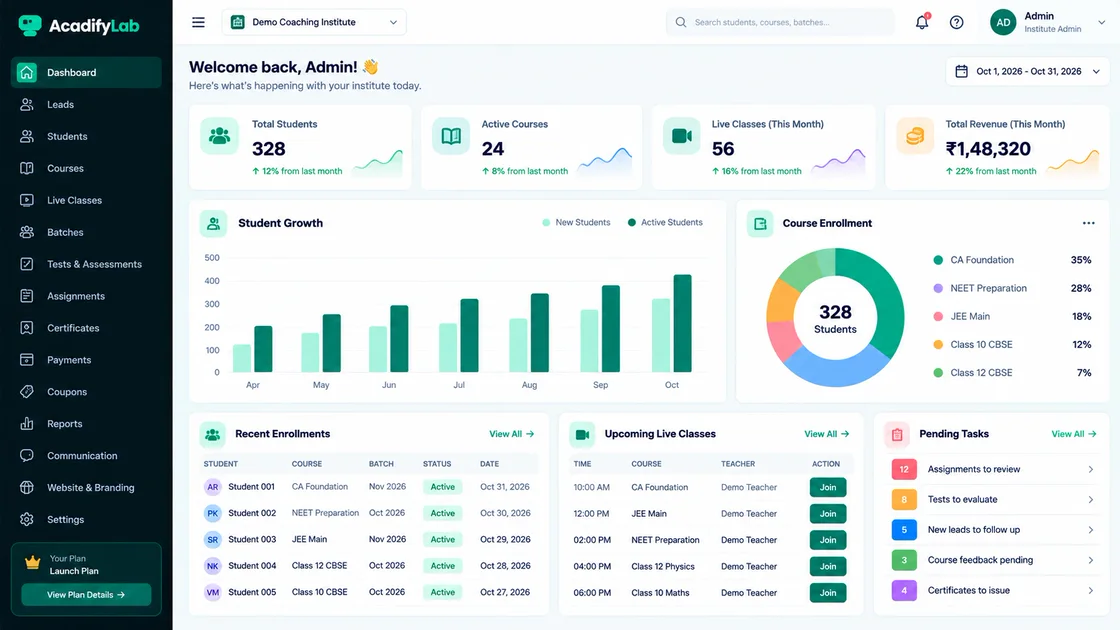
AcadifyLab
White-label LMS for coaching institutes and training businesses
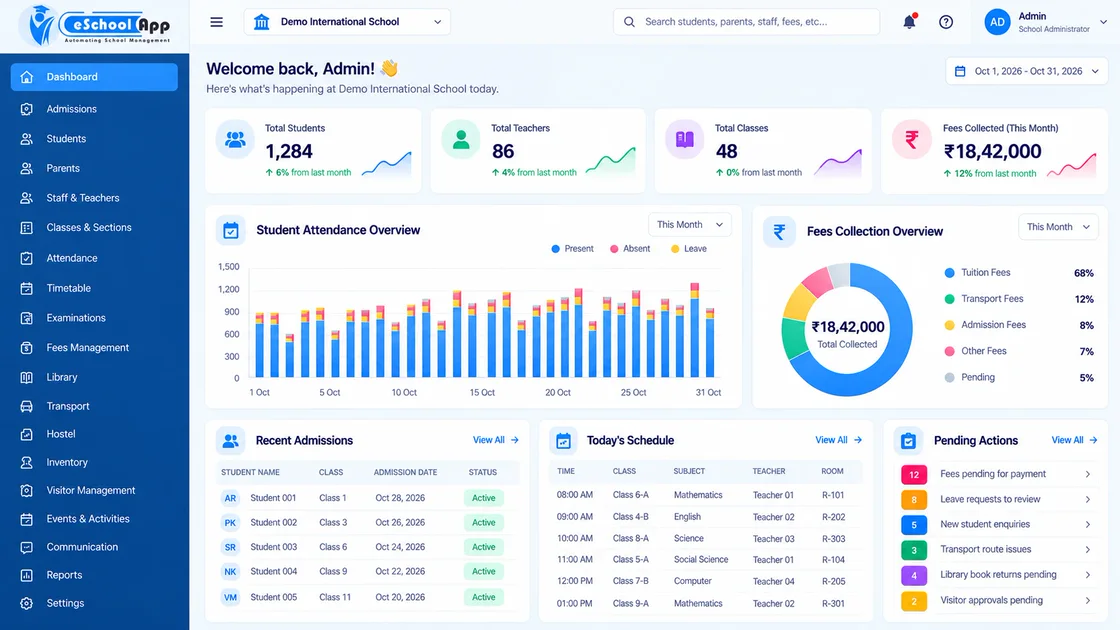
eSchoolApp
School ERP and management platform
Technology Selected for the Product
We select technology based on the product requirements, expected usage, integrations, development speed and long-term needs rather than forcing every MVP onto the same stack. We also design APIs so the product can connect with other services and future apps.
 React
 Node.js
 PostgreSQL
 MongoDB
 AWS
 Android
 iOS
 AI / LLMs
Product names and logos belong to their respective owners and are shown only to indicate the technologies we work with.
Launch Is Where the Learning Starts
Measure
Understand how people actually use the product.
Learn
Identify friction, missing functionality and assumptions that were wrong.
Prioritise
Decide what should be improved or developed next.
Iterate
Release improvements based on evidence rather than adding features blindly.
MVPs Aren’t Only for Startups
Startups
- Validate a new product idea
- Launch to early users
- Demonstrate the product
- Test a business model
- Prepare for the next development stage
Need technical leadership alongside the build? See our Virtual CTO services.
Existing Businesses
- Test a new digital service
- Replace a manual workflow
- Experiment with AI
- Validate an internal platform
- Test a new customer experience
- Digitise a new business process
What Determines MVP Development Cost?
What Determines the Timeline?
We agree scope and milestones during discovery, so you know what will be delivered and when.
Why Build Your MVP With BlinkWorx?
Product + Engineering Thinking
We consider both what should be built and how it should be built.
Full-Stack Development
Frontend, backend, database, APIs, cloud and mobile can be handled as one product.
AI Capability
AI can be tested as part of the MVP where it provides genuine value.
SaaS Experience
Experience building multi-user software products and platforms.
Own Product Experience
BlinkWorx develops and operates its own software products.
Continuity After MVP
The same product can continue evolving after the first launch.
MVP Development FAQs
What is a Minimum Viable Product?
A Minimum Viable Product (MVP) is a usable first version of a product that contains the essential functionality needed to solve the core user problem and collect meaningful feedback. It is real, working software for a focused scope, not a mock-up, and it is designed so it can grow into a fuller product.
What is the difference between an MVP and a prototype?
A prototype mainly tests design and user experience, usually through clickable screens, before any real development. An MVP is working software that real users can use to complete the core task, so it tests whether the product actually delivers value.
How much does MVP development cost in India?
Cost depends on the number of user roles, core workflows, whether you need web, mobile or both, UI complexity, backend and integration needs, payments, AI functionality and security requirements. Because these vary widely, we quote after a short discovery conversation instead of using a fixed price.
How long does it take to develop an MVP?
The timeline depends on the agreed scope, design requirements, integrations, technical complexity and how quickly feedback and approvals happen. We define milestones during discovery so you have a clear schedule before development starts.
How do you decide which features belong in the MVP?
We start from the core user journey and the most important assumptions you need to test. Features needed for that journey go into Version 1. Useful extras are planned for later, and ideas that add complexity without helping validation are held back.
Can you build a SaaS MVP?
Yes. Where appropriate, we build SaaS MVPs with the essential capabilities the initial product needs, such as user and organisation accounts, roles, and subscriptions or payments, designed so the platform can scale later.
Can you develop an AI MVP?
Yes. We develop AI MVPs such as AI assistants, agents, RAG applications, document processing and AI-enabled workflows where technically appropriate, so you can check quality, accuracy, costs and user experience before a larger build.
Should I build a web app or mobile app for my MVP?
It depends on how users need to interact with the product. Dashboards, SaaS tools and business applications usually start on the web. Products that depend on mobile access, notifications, camera or location may start as a mobile app. Some products need both from the start.
Can BlinkWorx continue development after the MVP launches?
Yes. After launch we can continue with improvements, new features, integrations, mobile apps, scaling and AI capabilities, using feedback and real usage to decide what to build next.
Do I need a complete technical specification before contacting BlinkWorx?
No. Start with the problem, the intended users and your product idea. We define the scope and technical approach together during discovery.
Have a Product Idea? Let’s Define What to Build First.
Tell us the problem, who the product is for and what you want users to accomplish. We’ll help you identify the right first version and what it would take to build.
You don’t need a complete feature list or technical specification to start.